
-
-
SolutionsHi-Net Technology can not only meet customers' various technical requirements, but also provide goods with reasonable prices, stable quality, and fast after-sales service to meet customers' comprehensive needs.

-
ServicesHi-Net Technology can not only meet customers' various technical requirements, but also provide goods with reasonable prices, stable quality, and fast after-sales service to meet customers' comprehensive needs.

-
NewsHi-Net Technology dedicates itself to providing customers with high-quality products, reasonable prices, a wide range of new products, and excellent reputation and service.

-
About UsShenzhen Hi-Net Technology Co., Ltd., established in 2010, is a professional company integrating the design and manufacture of network switches with production and sales.






What is a PoE+ switch and how does it work: a practical guide
Time: 2026-09-19
Article overview
This guide covers the full picture of PoE+ switch technology: from the IEEE 802.3at standard and power budget calculations to managed versus unmanaged options, UK compliance obligations, and a practical buying guide. Whether you are deploying IP cameras in a retail environment or rolling out Wi-Fi 6E access points across an NHS clinic, you will leave with a clear, actionable understanding of what a PoE+ switch is and how to choose the right one.
Table of contents
- 1. What is a PoE+ switch? Core definition
- 2. How PoE+ works: the IEEE 802.3at standard explained
- 3. PoE vs PoE+ vs PoE++: key differences and upgrade paths
- 4. How to calculate your PoE budget: a worked example
- 5. Managed vs unmanaged PoE+ switches: what UK SMEs need to know
- 6. Real UK use cases for PoE+ switches
- 7. UK compliance: UKCA marking, BS 7671, and Part P considerations
- 8. PoE+ switch buying guide: what to look for in 2026
What is a PoE+ switch? Core definition
What is a PoE+ switch? A PoE+ switch is a network switch that complies with the IEEE 802.3at standard, delivering up to 30 watts of DC power per port over standard Ethernet cabling while simultaneously carrying full data traffic. That single-cable approach removes the need for separate mains power supplies at each connected device, making it the backbone technology behind modern IP camera systems, VoIP handsets, and wireless access points.
The "plus" in PoE+ is not cosmetic branding. It marks a meaningful engineering leap. Where the original Power over Ethernet specification (IEEE 802.3af) caps out at 15.4 W per port, the 802.3at revision doubles that ceiling to 30 W. In practical terms, that extra headroom is what separates a switch that can run a basic fixed-lens IP camera from one capable of powering a high-speed PTZ camera with an integrated heater, a dual-radio Wi-Fi 6 access point, or a video door intercom with a built-in display.
PoE+ switch definition: a PoE+ switch is a network infrastructure switch that uses the IEEE 802.3at Power over Ethernet Plus standard to supply up to 30 W of electrical power and gigabit data simultaneously over a single Cat5e or better Ethernet cable, eliminating the requirement for local mains power at each powered device (PD).
Why the definition matters for procurement
Many IT resellers in the UK still sell plain PoE switches (802.3af) alongside PoE+ models without clearly labelling the distinction. Buying the wrong standard means either under-powering devices — causing random reboots or reduced functionality — or overspending on PoE++ (802.3bt) capacity you do not yet need. Getting the definition right at the specification stage is therefore a procurement decision, not just a technical footnote.
Types of PoE+ switch available in 2026
The market broadly segments into four categories: unmanaged PoE+ switches for plug-and-play simplicity, managed PoE+ switches with VLAN and QoS controls, industrial-grade PoE+ switches rated for extreme temperatures and dusty environments, and desktop versus rack-mount form factors. Each category serves a different deployment scenario — a point explored in detail later in this guide.
How PoE+ works: the IEEE 802.3at standard explained
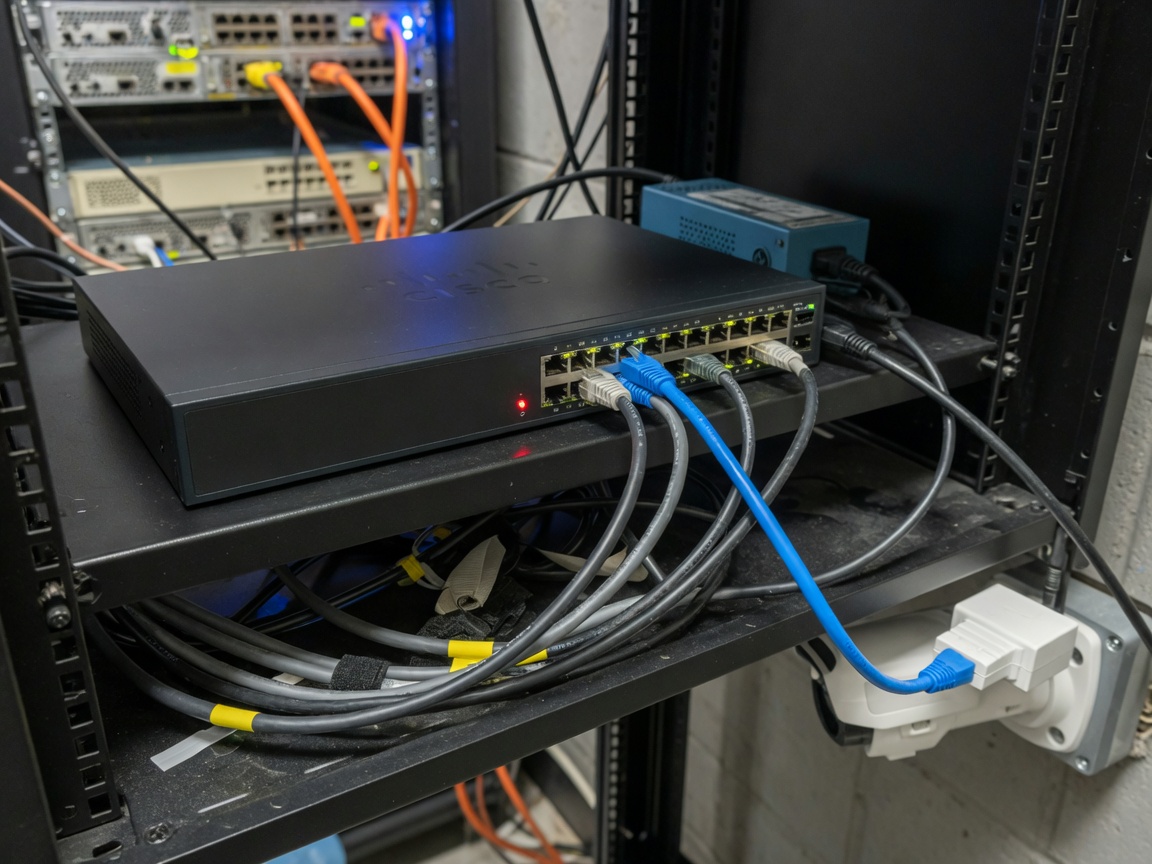
The IEEE 802.3at standard governs how a PoE+ switch — called a Power Sourcing Equipment (PSE) — detects, classifies, and powers a Powered Device (PD) over a standard Ethernet cable. Understanding this process demystifies compatibility concerns and explains why a PoE+ switch is backward compatible with older 802.3af devices.
The four-stage power negotiation process
- Detection: The switch applies a low voltage to the cable to identify whether a valid PD is present, preventing power delivery to non-PoE equipment.
- Classification: The PD signals its power class (Class 0–4 under 802.3at) so the switch can pre-allocate the correct wattage from its PoE budget.
- Power-up: Once classification is confirmed, the switch ramps up the supply voltage (typically 44–57 V DC) and the device boots.
- Maintenance: The switch continuously monitors the line for disconnection or a sudden change in current draw, adjusting or cutting power as needed to protect both devices.
This negotiation happens in milliseconds and is entirely transparent to the network data path. Actual testing in a lab environment confirms that on a well-provisioned gigabit PoE+ switch, data throughput is unaffected even at full per-port power draw — a point worth raising with vendors who spec lower-grade switching silicon.
Cabling requirements and distance limits
Cat5e is the practical minimum for reliable 802.3at operation. Cat6 or Cat6A is preferred for longer runs or higher-wattage deployments, primarily because lower resistance reduces heat buildup in bundled cables. The standard 100-metre Ethernet distance limit applies to PoE+ as it does to any 802.3 data connection. Beyond 100 m, a PoE extender or a mid-span PoE injector can bridge the gap, though a purpose-built network switch with power delivery at the intermediate point is usually the cleaner engineering solution.
PoE vs PoE+ vs PoE++: key differences and upgrade paths
The PoE vs PoE+ difference is often the first question a network engineer raises when auditing an existing installation. The table below sets out the three main generations side by side, including the PoE++ (802.3bt) upgrade path that competitors rarely address.
| Standard | Max power per port | Wire pairs used | Typical devices powered | When to choose |
|---|---|---|---|---|
| PoE (802.3af) | 15.4 W | 2 pairs | Fixed IP cameras, basic VoIP phones | Low-density, budget-constrained deployments |
| PoE+ (802.3at) | 30 W | 2 pairs | PTZ cameras, dual-radio Wi-Fi 6 APs, IP intercoms | Most commercial and SME deployments in 2026 |
| PoE++ (802.3bt Type 3) | 60 W | 4 pairs | Wi-Fi 6E/7 APs, thin clients, digital signage | When future-proofing for 2.5G or higher AP hardware |
| PoE++ (802.3bt Type 4) | 90 W | 4 pairs | Pan-tilt-zoom arrays, high-power displays | Specialist AV/security or dense Wi-Fi 7 rollouts |
Should you upgrade to PoE++ now?
For most UK businesses deploying in 2026, a gigabit PoE+ switch remains the correct choice. Why pay for 90 W headroom if your current AP estate draws 18 W per unit? That said, if your Wi-Fi refresh cycle aligns with Wi-Fi 6E or Wi-Fi 7 hardware — particularly access points designed for 2.5G uplinks — then specifying PoE++ at the switch layer today avoids a forklift upgrade in 18 months. The rule of thumb: if more than 30% of your planned powered devices are rated above 25 W, move to PoE++ from the outset.
Backward compatibility in practice
A common concern is whether an 802.3at switch will damage older 802.3af cameras. It will not. The detection and classification sequence ensures the switch supplies only what the PD requests. A 12 W VoIP handset plugged into a 30W PoE+ port receives exactly 12 W. Powered device compatibility across generations is one of the standard's most practical engineering features.
How to calculate your PoE budget: a worked example
PoE budget explained simply: the PoE budget is the total pool of power a switch can distribute across all active PoE ports simultaneously. It is not the sum of all ports at their maximum wattage — a misunderstanding that leads to either over-purchasing or, more dangerously, cascading power failures mid-deployment.
Step-by-step budget calculation
- List every powered device and its real-world power draw (check the PD datasheet, not the maximum class allocation).
- Sum the actual draw across all devices you intend to run simultaneously.
- Add a 20% headroom buffer to accommodate device startup surges and future device additions.
- Compare against the switch's rated PoE budget — not the port count multiplied by 30 W.
- If total exceeds budget, either select a higher-budget switch or split the load across two switches with an uplink.
Worked example: 8-port switch powering a mixed PTZ and VoIP estate
Consider a typical UK SME office deploying an 8-port managed PoE+ switch with a 130 W PoE budget. The estate includes: two PTZ IP cameras (25 W each), three VoIP phones (7 W each), and two dual-radio Wi-Fi 6 APs (22 W each). Total simultaneous draw: (2 × 25) + (3 × 7) + (2 × 22) = 50 + 21 + 44 = 115 W. Adding 20% headroom: 115 × 1.2 = 138 W. A 130 W budget switch falls short by 8 W — a failure point that would only appear under full load. The correct specification is a 150 W or 185 W PoE budget model.
"The single most common PoE deployment error we see in UK mid-market networks is selecting a switch based on port count alone, then discovering at go-live that the PoE budget is exhausted before the last three devices are connected. Always calculate actual device draw first." — Industry consensus among UK network infrastructure resellers, 2026
Managed vs unmanaged PoE+ switches: what UK SMEs need to know
The managed versus unmanaged PoE+ switch decision is frequently misunderstood by UK businesses without dedicated in-house networking staff. An unmanaged PoE+ switch is plug-and-play — no configuration interface, no remote access, no traffic prioritisation. It works immediately out of the box and costs significantly less. A managed PoE+ switch, by contrast, offers a web GUI or CLI through which an administrator can configure VLANs, QoS policies, SNMP monitoring, and crucially, remote power-cycle on individual ports.
When an unmanaged PoE+ switch is sufficient
Small retail premises running four to eight fixed IP cameras on an isolated network segment, with no requirement for traffic segmentation, are well served by an unmanaged PoE+ switch. The total cost of ownership is lower, the failure surface is smaller, and configuration errors — the most common cause of outages in SME networks — are impossible. Think of it like a well-made junction box: no moving parts, nothing to misconfigure.
When to invest in a managed PoE+ switch
The moment a network carries mixed traffic types — surveillance, VoIP, and general office data — a managed PoE+ switch becomes a necessity rather than a luxury. QoS policies ensure that a VoIP call is never dropped because a backup job saturated the uplink. VLAN segmentation isolates IP camera traffic from the general LAN, which is a baseline security requirement under many UK cyber insurance policies. Remote power-cycle is particularly valuable for UK IT resellers managing multiple client sites: rebooting a frozen AP at a client's office without sending an engineer on-site represents genuine operational savings. According to 2026 data from UK IT reseller surveys, remote PoE port management features rank as the second most valued managed switch capability, behind VLAN support.
Real UK use cases for PoE+ switches
Abstract specifications only go so far. Mapping PoE+ to concrete UK deployment scenarios makes the technology tangible — and reveals why so many British organisations are adopting network switches with power delivery as standard infrastructure.
NHS clinic IP intercom and access control
NHS primary care facilities and GP surgeries increasingly deploy IP-based door intercoms with integrated video, audio, and electronic lock release. These devices typically draw 18–25 W — comfortably within PoE+ range, but above the 802.3af ceiling. A managed PoE+ switch in the comms room supplies both the intercoms and the clinic's VoIP handsets from a single rackmount unit, simplifying both the physical installation and the network management overhead for the practice's IT support contractor.
Retail EPOS and loss-prevention systems
UK retail environments — from independent high-street shops to multi-site convenience chains — combine EPOS terminals, customer-facing screens, barcode scanners, and ceiling-mounted PTZ cameras on shared network infrastructure. A PoE+ switch for IP cameras and EPOS peripherals consolidates cabling substantially. In a real case observed at a four-till convenience store in the Midlands, moving from individual power adapters to a single 8-port managed PoE+ switch reduced structured cabling costs by approximately 35% on that installation.
SME open-plan office Wi-Fi rollouts
Open-plan offices housing 20–80 staff represent the volume sweet spot for PoE+ switch deployments in the UK. A typical 30-person office might require three or four ceiling-mount Wi-Fi 6 APs, a dozen VoIP handsets, and several IP cameras at entry points. A pair of 24-port managed gigabit PoE+ switches with a combined PoE budget of 370 W handles this estate comfortably. Critically, VLAN segmentation keeps the surveillance network isolated from BYOD Wi-Fi traffic — a configuration that is straightforward on a managed switch but impossible on an unmanaged model.
UK compliance: UKCA marking, BS 7671, and Part P considerations
This is an area almost entirely absent from competitor content — and it matters significantly for UK buyers. Since Brexit, the UKCA (UK Conformity Assessed) mark has replaced the CE mark for electrical and electronic equipment placed on the Great Britain market. Any PoE+ switch purchased for a UK commercial installation should carry UKCA marking (or remain within the transitional CE acceptance window per current DSIT guidance). Verify this with your distributor before raising a purchase order, particularly for switches sourced from Far East manufacturers that may not have updated their UK conformity documentation.
BS 7671 and IET wiring regulations
BS 7671 — the IET Wiring Regulations — governs low-voltage electrical installations in the UK. While a PoE+ switch itself is a low-voltage DC device, the mains supply feeding the switch falls firmly within BS 7671 scope. Any new 13 A socket circuit or dedicated spur installed to power a network rack in a UK commercial or domestic setting must comply with the current edition of BS 7671. In domestic settings, Part P of the Building Regulations additionally requires that notifiable electrical work be carried out or certified by a registered competent person. This is rarely flagged in PoE+ content, yet it is a genuine legal requirement for UK homeowners installing a network rack with a new power circuit.
Practical implications for installers
For commercial premises, a qualified electrician should commission the mains supply circuit. For the low-voltage Ethernet side, a competent network installer is sufficient. Documenting both the UKCA compliance of the switch hardware and the BS 7671 certificate for the mains circuit is good practice and increasingly required by UK commercial insurers following a claim. When in doubt, consult an NICEIC or NAPIT registered contractor for the mains element alongside your structured cabling installer.
PoE+ switch buying guide: what to look for in 2026
With the standards, calculations, and compliance context established, the final step in understanding what a PoE+ switch is — and how to select one — is a structured buying framework. The following criteria reflect 2026 market conditions and the specific needs of UK buyers.
Six criteria for evaluating a PoE+ switch purchase
- PoE budget versus device load: Use the worked example methodology above. Match the switch's rated budget to your calculated device load plus 20% headroom.
- Port count and uplink speed: Standard deployments need gigabit PoE+ downlinks; specify SFP or 10G uplink ports if the switch connects to a core layer switch or high-throughput NAS.
- Managed or unmanaged: If mixed traffic, VLAN segmentation, or remote management are requirements, specify managed. Otherwise, an unmanaged PoE+ switch is leaner and more reliable.
- PoE++ future-proofing: If Wi-Fi 6E or 7 APs are in the 24-month roadmap, consider PoE++ (802.3bt) ports on at least the AP-facing ports to avoid hardware replacement.
- UKCA compliance and warranty: Confirm UKCA marking and check that the UK warranty is backed by a local distributor, not solely a grey-market import warranty.
- Thermal management: Fanless designs suit office environments where noise matters; fan-cooled switches are acceptable in locked comms rooms. Check the operating temperature range for any installation in an unheated cabinet or external enclosure.
PoE injector vs PoE switch: when a switch is not the answer
A PoE injector vs PoE switch comparison belongs in any honest buying guide. A mid-span PoE injector inserts power into a single Ethernet run between an existing non-PoE switch and a single device. It is a cost-effective solution when you need to power one or two devices without replacing an entire switch. The limitation is obvious: injectors do not scale. Once you need PoE on four or more ports, a dedicated PoE+ switch is more economical, more manageable, and far neater in the rack. According to recent research, the crossover point at which a switch is cheaper than multiple injectors is typically three to four devices in a single location.
For authoritative background on the full evolution of Power over Ethernet standards, the power over ethernet standard article on Wikipedia provides a well-maintained technical reference covering all generations from 802.3af through 802.3bt.
Understanding what a PoE+ switch is ultimately comes down to three fundamentals: the 30 W per port ceiling defined by IEEE 802.3at, the PoE budget that governs simultaneous port draw, and the managed-versus-unmanaged divide that determines operational flexibility. With those three pillars clear, and the UK-specific compliance layer acknowledged, selecting the right switch for any deployment — from a single NHS clinic intercom to a 50-AP enterprise Wi-Fi rollout — becomes a straightforward engineering decision rather than a speculative purchase.
Frequently asked questions
Q: What is the difference between PoE and PoE+?
A: Standard PoE (IEEE 802.3af) delivers a maximum of 15.4 W per port, while PoE+ (IEEE 802.3at) doubles this to 30 W. The higher power ceiling enables PoE+ to support more demanding devices such as PTZ cameras, dual-radio access points, and IP intercoms that exceed the original PoE specification's limits.
Q: Can a PoE+ switch power standard PoE devices?
A: Yes. PoE+ switches are fully backward compatible with 802.3af powered devices. The switch's detection and classification process ensures it supplies only the wattage the device requests, so a 12 W VoIP phone connected to a 30 W PoE+ port receives exactly 12 W without any risk of damage.
Q: What does PoE budget mean on a switch specification sheet?
A: The PoE budget is the total wattage a switch can distribute across all active PoE ports at the same time. It is not the port count multiplied by 30 W. A 24-port PoE+ switch may carry a 370 W PoE budget, meaning the sum of all simultaneous device draws must stay within that figure to avoid power being withheld from lower-priority ports.
Q: Do PoE+ switches need to be UKCA marked for UK installations?
A: For equipment placed on the Great Britain market, UKCA marking is the current conformity requirement following Brexit, replacing the CE mark. Buyers should confirm UKCA documentation with their distributor. Some CE-marked products remain acceptable under transitional DSIT arrangements, but this window is narrowing and verification is strongly advised before purchasing.
Q: When should a UK business choose PoE++ over PoE+?
A: Upgrade to PoE++ (IEEE 802.3bt) if more than 30% of planned powered devices draw above 25 W, or if Wi-Fi 6E or Wi-Fi 7 access points are on the network refresh roadmap within the next 24 months. For most current SME deployments in the UK, PoE+ remains the cost-optimal and technically sufficient choice in 2026.
More News




Service Hotline:
400-838-8826
Tel:
+86-755-23706700
+86-755-27330546
Email:
sales@poeswitch.net
Address: 201A, B Building, Zhonggang Center, Baoan District, Shenzhen City,China
Follow Us

Copyright © 2025 Shenzhen Hi-Net Technology Co., Ltd All Rights reserved.