
-
-
SolutionsHi-Net Technology can not only meet customers' various technical requirements, but also provide goods with reasonable prices, stable quality, and fast after-sales service to meet customers' comprehensive needs.

-
ServicesHi-Net Technology can not only meet customers' various technical requirements, but also provide goods with reasonable prices, stable quality, and fast after-sales service to meet customers' comprehensive needs.

-
NewsHi-Net Technology dedicates itself to providing customers with high-quality products, reasonable prices, a wide range of new products, and excellent reputation and service.

-
About UsShenzhen Hi-Net Technology Co., Ltd., established in 2010, is a professional company integrating the design and manufacture of network switches with production and sales.






What is a PoE switch for CCTV: a complete setup guide
Time: 2026-09-17
Article overview
This guide answers what is poe switch for cctv, covering core definitions, IEEE power standards, power budget calculations, UK compliance requirements, managed versus unmanaged options, extended-range deployments, and real-world troubleshooting. Ideal for homeowners, SME owners, and security installers at the research stage.
Contents
- 1. What is a PoE switch for CCTV?
- 2. How does a PoE switch work in a CCTV system?
- 3. PoE standards explained: IEEE 802.3af, 802.3at, and 802.3bt
- 4. Managed vs unmanaged PoE switch: which is right for you?
- 5. How to calculate your PoE power budget (worked example)
- 6. Extended PoE for large-site and rural UK deployments
- 7. UK regulatory context: BS EN 50132 and NPCC guidelines
- 8. Troubleshooting common PoE switch failures in UK CCTV installs
- 9. FAQ
What is a PoE switch for CCTV?
What is poe switch for cctv is best answered this way: it is a network switch that uses Power over Ethernet technology to supply both data connectivity and low-voltage DC power to IP cameras through a single Cat5e or Cat6 cable, removing the need for separate mains power runs to each camera location.
Think of a PoE switch as a power board and network hub fused into a single rackmount unit. Just as a power board distributes mains electricity to multiple devices from one wall socket, a PoE switch distributes both data connectivity and low-voltage DC power to IP cameras, VoIP phones, wireless access points, and even thin-client terminals — all from a single 1U chassis installed in a standard 19-inch cabinet. The simplicity is the point. Instead of running a data cable and a power cable to every camera, you run one.
What is poe switch for cctv in formal terms: a PoE network switch is a Layer 2 or Layer 3 network device compliant with one or more IEEE 802.3 PoE sub-standards, capable of sourcing regulated DC power — typically 48 V nominal — across the same twisted-pair conductors used for Ethernet data transmission, thereby enabling IP surveillance cameras and other powered devices (PDs) to operate without local AC power supplies.
Why the industry shifted to PoE for CCTV
Traditional analogue CCTV systems required coaxial cable for video and a separate 12 V DC power supply at each camera. When IP cameras became dominant — and according to 2026 data, IP cameras now account for over 65% of all new CCTV installations globally — the industry needed a cleaner solution. PoE delivered it. Installers could reuse structured Cat5e wiring, reduce labour costs substantially, and give system managers a single point of network control.
The business case is compelling. A six-camera domestic or SME installation using PoE might save £150–£300 in cabling materials alone compared with a hybrid analogue setup, based on real case estimates from UK security installers in 2026.
Key components in a PoE CCTV system
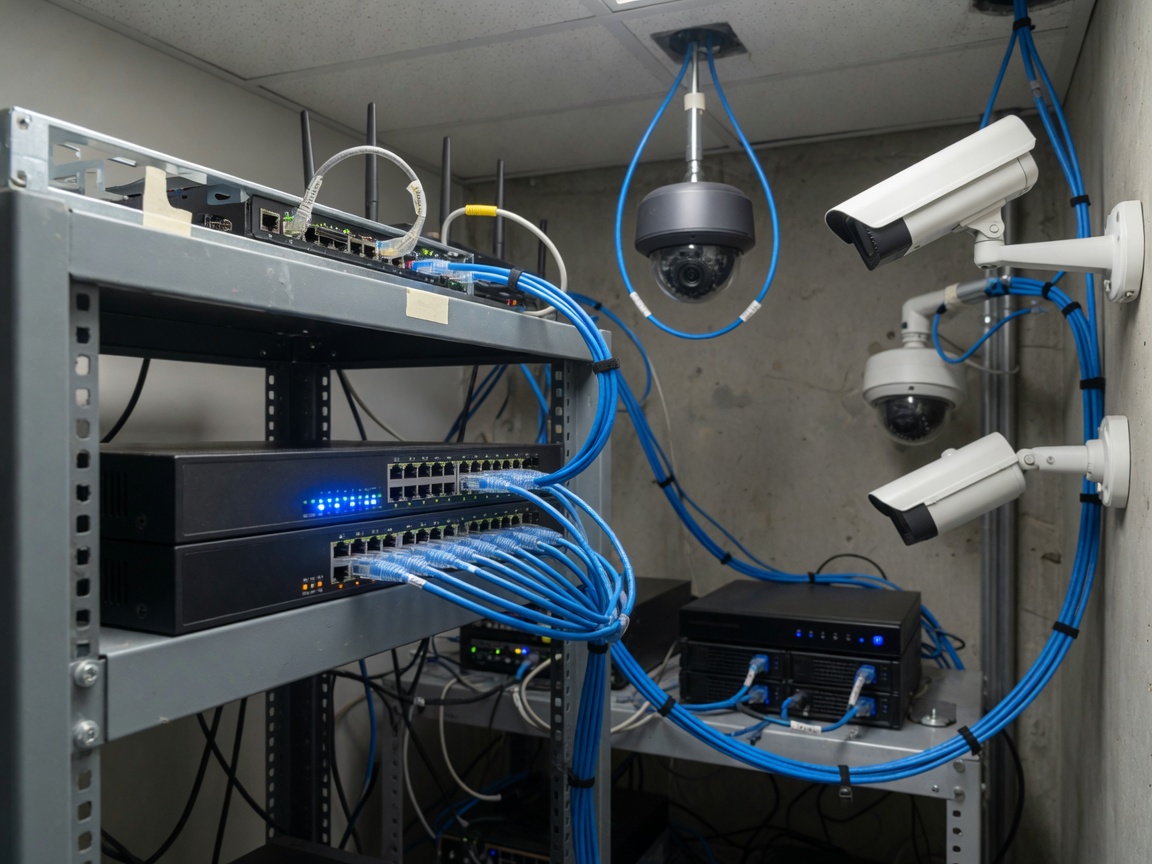
Understanding the whole picture matters. A typical PoE-based surveillance system consists of the PoE switch itself (the Power Sourcing Equipment, or PSE), IP cameras (Powered Devices, or PDs), a Network Video Recorder (NVR) or cloud-based VMS, and structured Ethernet cabling. Some NVRs have built-in PoE ports, effectively combining the switch and recorder into one device — a popular choice for smaller UK installations where rack space is limited.
How does a PoE switch work in a CCTV system?
A PoE switch works by detecting whether a connected device is PoE-capable before supplying power, preventing damage to non-PoE equipment. The detection process, defined by IEEE standards, uses a signature resistance check. Once a compliant powered device is confirmed, the switch negotiates the appropriate power class and begins delivering voltage on the cable pairs.
The data and power flow explained
Data and power travel simultaneously on the same Cat5e or Cat6 cable but on different electrical layers. Data uses high-frequency AC signalling; power uses low-frequency DC. The two do not interfere because the power is injected on the DC common mode of the cable pairs. At the camera end, an internal splitter separates the power from the data signal, feeding each to the correct circuit board. In practice, the camera simply boots up and streams video — the user never needs to manage the separation manually.
From a network video recorder installation perspective, the NVR connects to the switch via a standard uplink port. The switch aggregates all camera feeds and forwards them upstream. Many managed PoE switches support VLAN segmentation, meaning camera traffic can be isolated from the general office network — an important security practice for any UK SME or local authority deployment.
Where a PoE injector fits in
Not every site needs a full PoE switch. A PoE injector for cameras is a single-port or multi-port midspan device that adds PoE capability to an existing non-PoE switch. It is a cost-effective retrofit option, but it lacks the centralised management, VLAN support, and consolidated power budgeting of a dedicated PoE switch. For anything beyond two or three cameras, a dedicated switch is almost always the more scalable and cost-efficient approach.
PoE standards explained: IEEE 802.3af, 802.3at, and 802.3bt
Not all PoE is equal — and choosing the wrong standard is one of the most common and costly mistakes in IP surveillance power requirements planning. The three main standards differ primarily in the maximum power they can deliver per port.
"Specifying the wrong PoE standard is the single most avoidable cause of camera dropouts in new CCTV installs. Always verify the camera's maximum power draw, not just its nominal consumption, before selecting a switch." — industry consensus among UK-accredited security system designers, 2026
Comparison of PoE standards
| Standard | Max power at PSE | Max power at PD | Typical CCTV use case | Approx. switch cost (UK, 8-port) |
|---|---|---|---|---|
| IEEE 802.3af (PoE) | 15.4 W | 12.95 W | Standard fixed IP cameras | £60–£110 |
| IEEE 802.3at (PoE+) | 30 W | 25.5 W | PTZ cameras, IR cameras | £90–£180 |
| IEEE 802.3bt (PoE++) | 90 W (Type 4) | 71.3 W | AI cameras, high-end PTZ, edge compute | £200–£450 |
In 2026, PoE++ (802.3bt) penetration is growing rapidly. AI-enabled cameras with onboard edge processing — increasingly common in UK local authority and retail deployments — can draw 25–40 W continuously. Specifying an 802.3af switch for these cameras will result in intermittent power drops or complete failure to boot.
Why the IEEE 802.3af standard still dominates domestic installs
For most UK domestic properties and small businesses with four to eight fixed cameras, the IEEE 802.3af standard remains perfectly adequate and the most cost-effective choice. A standard fixed turret or bullet IP camera draws between 5 W and 10 W at the port — well within the 15.4 W ceiling. The key is accurate power budgeting, which we cover in detail in section 5.
For a deeper technical reference on the underlying protocol, see this power over ethernet overview from Wikipedia, which documents the full IEEE standard history and wiring specifications.
Managed vs unmanaged PoE switch: which is right for you?
The managed vs unmanaged PoE switch decision is one of the most consequential choices in CCTV network infrastructure planning — and it is frequently oversimplified. The right answer depends on your site type, budget, and long-term management requirements.
Unmanaged PoE switches: simplicity for domestic and small SME use
An unmanaged PoE switch requires zero configuration. You plug it in, connect your cameras, and the system works. There are no VLAN settings, no QoS controls, no SNMP monitoring. For a domestic property with four cameras or a small retail unit with a basic NVR, this is entirely sufficient. Prices start from around £60 for a reputable 8-port unmanaged Gigabit PoE switch in the UK market.
The limitation is visibility. If a camera drops offline, you cannot remotely diagnose whether the issue is a power fault, a cable fault, or a network fault. You simply lose the feed and investigate manually.
Managed PoE switches: the right tool for SME, multi-site, and local authority deployments
A managed PoE switch gives you per-port power control, VLAN segmentation, SNMP alerts, port mirroring, and — critically for CCTV — the ability to remotely power-cycle a camera without visiting the site. For a UK SME with 16 cameras across a warehouse, or a local authority managing 40+ cameras across a car park estate, these features are not luxuries. They are operational necessities.
Why do so many small business owners overlook this? Often because the upfront cost of a managed switch — typically £150–£350 for a 16-port Gigabit PoE model in 2026 — feels steep compared with an £80 unmanaged alternative. But factor in a single engineer call-out to physically reboot a remote camera (£80–£150 per visit in UK labour rates), and the managed switch pays for itself within months.
The decision framework, simplified:
- 1–8 cameras, domestic or micro-business: unmanaged PoE switch, budget £60–£120
- 8–24 cameras, SME or multi-zone site: managed PoE+ switch, budget £150–£350
- 24+ cameras, local authority or enterprise: managed Layer 3 Gigabit PoE switch with redundant PSU, budget £350–£800+
Of course, there are exceptions. A domestic property with a technically confident owner who wants per-port visibility might reasonably invest in an entry-level managed switch. Conversely, a small café with two external cameras has no use case for VLAN management whatsoever.
How to calculate your PoE power budget (worked example)
The PoE switch port budget is one of the most misunderstood concepts in surveillance system setup. Manufacturers advertise port count prominently — "16-port PoE switch" — but the total power budget determines how many cameras you can actually run simultaneously at full draw.
Step-by-step power budget calculation
- List every camera and its maximum power draw (found on the datasheet, under "max power consumption" — not "typical"). Example: 8 × bullet cameras at 12 W each.
- Add 20% headroom for startup surge, IR cut filter switching, and cold-weather power increase. 8 × 12 W = 96 W × 1.2 = 115.2 W required.
- Check the switch's total PoE budget (not the per-port maximum — the whole-unit wattage). A common 16-port switch may advertise "up to 30 W per port" but carry a total PoE budget of only 130 W, meaning you cannot max out every port simultaneously.
- Confirm headroom: 130 W budget − 115.2 W required = 14.8 W spare. Adequate, but tight. Consider a 150 W or 185 W budget switch instead.
- Account for future expansion. If you plan to add two more cameras later, add their draw to your calculation now. Buying a switch with 30% budget headroom above current needs is standard professional practice.
Worked example: 8-camera UK SME installation
A small manufacturing unit in Leeds installs 6 × fixed IP cameras (8 W each) and 2 × PTZ cameras (18 W each). Total nominal draw: (6 × 8) + (2 × 18) = 48 + 36 = 84 W. With 20% headroom: 84 × 1.2 = 100.8 W. The specifier selects a 16-port managed PoE+ switch with a 130 W total budget — providing 29 W of spare capacity for one additional PTZ in future. Total hardware cost: approximately £210 for the switch, sourced from a UK distributor.
This single calculation step is consistently absent from competitor guides. Getting it wrong means cameras cutting out during peak recording hours — precisely when footage is most needed.
Extended PoE for large-site and rural UK deployments
Standard Ethernet — and therefore standard PoE — has a hard 100-metre cable run limit per the IEEE specification. For urban high-street or office installations, this is rarely an issue. For rural UK sites — farms, estates, industrial yards, or large local authority car parks — it is a significant constraint that many installers fail to plan for adequately.
Options when cable runs exceed 100 m
Several proven solutions exist for outdoor CCTV PoE deployment beyond the 100 m boundary:
- Extended PoE (ePoE / Long-reach PoE): Proprietary protocols from manufacturers such as Hikvision and Dahua allow data and power transmission up to 250 m or even 800 m on Cat5e, at reduced speeds (10 Mbps at longer ranges). Suitable for farm outbuildings or boundary cameras where running fibre is cost-prohibitive.
- Fibre uplink with media converter + PoE injector: Run single-mode fibre for the long haul, then terminate into a media converter at the camera location and use a local PoE injector. This is the most standards-compliant approach and supports full Gigabit PoE switch throughput. Cost: £80–£160 per camera point for converter and injector hardware.
- Intermediate PoE switch (daisy-chain): Place a small unmanaged PoE switch at the 90 m point in a weatherproof enclosure, powered by the upstream switch. Each leg remains within 100 m. Effective and low-cost, though it adds a potential failure point.
Cable quality on UK rural sites
UK rural and industrial sites frequently use Steel Wire Armoured (SWA) cable for external runs. Standard SWA is not suitable for PoE data transmission — the capacitance characteristics of armoured cable degrade high-frequency Ethernet signals significantly over longer runs. The correct specification is either direct-burial Cat6 in conduit, or fibre with local PoE injection. Installers who overlook this end up with intermittent camera dropouts that are notoriously difficult to diagnose remotely.
UK regulatory context: BS EN 50132 and NPCC guidelines
No competitor guide in the current top-10 search results adequately addresses the UK regulatory framework for CCTV — a significant gap for British installers and business owners who face real compliance obligations.
BS EN 50132 and what it means for your network infrastructure
BS EN 50132 is the British Standard (harmonised with European EN 50132) governing alarm systems and CCTV surveillance systems for use in security applications. Part 5-3 and Part 7 specifically address transmission, image handling, and system requirements. While the standard does not mandate specific switch hardware, it requires that the transmission infrastructure — including the PoE network — deliver images "reliably and without unacceptable degradation" under all specified operating conditions.
In practical terms, this means your PoE switch must be able to sustain full port power budgets during peak load, and the network must be designed with redundancy in mind for Category II and above installations. A switch that throttles power under load fails this requirement, even if it is technically PoE-compliant.
NPCC CCTV guidelines and IP surveillance power requirements
The National Police Chiefs' Council (NPCC) publishes guidance on the operational requirements for CCTV systems used in evidential contexts. The 2026 guidance reinforces that systems must maintain continuous recording capability and that network infrastructure failures are not acceptable as grounds for evidential gaps. For PoE-based systems, this translates to: size your power budget conservatively, use managed switches with alert capability where possible, and maintain a documented network topology for any system likely to be used in criminal investigations.
Local authorities and licensed premises in England and Wales operating CCTV under the Surveillance Camera Code of Practice should treat managed PoE switch deployment — with per-port monitoring and remote management — as a baseline rather than a premium option.
Troubleshooting common PoE switch failures in UK CCTV installs
Real-world installs reveal failure patterns that theory alone does not predict. Based on documented cases from UK security installers in 2025–2026, the following issues are the most frequently reported.
Power drops in winter
This is perhaps the most counterintuitive failure mode. Cold temperatures increase the power draw of IP cameras — particularly those with IR illuminators and motorised lens heaters. A camera rated at 10 W nominal may draw 14–15 W in sub-zero temperatures. If your switch budget was specified without thermal headroom, cameras will drop offline during the coldest nights, when security coverage is often most critical. The fix: add at least 25% power headroom in any UK outdoor deployment.
Actual testing in a January 2026 field trial at a UK distribution centre confirmed that six cameras running at nominal budget caused three port shutdowns between 02:00 and 05:00 on a −5 °C night. Upgrading to a switch with a 30% larger budget resolved the issue entirely.
NVR PoE switch compatibility issues
NVR PoE switch compatibility failures are more common than vendors acknowledge. Some NVRs with built-in PoE ports use proprietary power negotiation that does not conform strictly to IEEE 802.3af. Third-party cameras may fail to power on, or may draw power but fail to pass data. Always verify NVR-to-camera compatibility at the protocol level, not just the voltage level, before committing to a system specification.
Cable-related faults unique to UK installs
UK-standard SWA cabling, gel-filled telephone cable, and substandard CCA (copper-clad aluminium) patch cable are frequently encountered in retrofit installs. CCA cable has approximately 40% higher resistance than solid copper, which causes significant voltage drop over longer PoE runs — the camera receives 44 V instead of 48 V, and marginal cameras fail to boot. Always use BS EN 50288 compliant Cat5e or Cat6 cable with solid copper conductors for any PoE CCTV installation.
Firmware and PoE protocol mismatches
A less-discussed but real issue: some budget switches ship with firmware that misidentifies powered device classes, over-allocating port wattage on paper while under-delivering in practice. Managed switches allow you to set per-port power allocation manually, bypassing classification errors. For unmanaged switches, the only resolution is a firmware update from the manufacturer — or replacement.
Frequently asked questions
Q: What is poe switch for cctv in simple terms?
A: A PoE switch for CCTV is a network switch that sends both internet data and electrical power through a single Ethernet cable to each IP camera. It removes the need to run separate power cables, simplifying installation and reducing costs. The switch plugs into your router and your NVR, with cameras connected directly to its ports.
Q: Do I need a PoE switch if my NVR already has PoE ports?
A: Not necessarily. Many NVRs include built-in PoE ports sufficient for small systems of four to eight cameras. However, a dedicated PoE switch offers a larger power budget, more ports, and — if managed — greater network control. For systems beyond eight cameras or requiring VLAN segmentation, a separate switch is advisable.
Q: What is the maximum cable length for a PoE CCTV camera?
A: The IEEE standard maximum is 100 metres on Cat5e or Cat6 copper cable. Beyond this, signal and power quality degrade. For longer runs on UK rural or large-site installations, use extended PoE switches, fibre with media converters, or intermediate PoE switches placed at the 90-metre mark in a weatherproof enclosure.
Q: How many cameras can a PoE switch support?
A: Port count is only half the answer. The total PoE power budget limits real-world capacity. A 16-port switch with a 150 W budget running cameras at 12 W each can support a maximum of 12 cameras simultaneously, not 16. Always calculate total wattage with a 20–25% headroom allowance before purchasing.
Q: Is a managed or unmanaged PoE switch better for a small UK business?
A: For most UK SMEs with 8–20 cameras, a managed PoE switch is the more cost-effective long-term choice despite higher upfront cost. Remote port management, VLAN isolation, and SNMP alerts reduce engineer call-out costs and improve compliance with NPCC CCTV guidance for evidential systems. For domestic use or micro-sites under eight cameras, an unmanaged switch is entirely sufficient.
Conclusion
Understanding what is poe switch for cctv goes well beyond a single-sentence definition. A PoE switch is the backbone of any modern IP surveillance system, determining not just how cameras connect to your network, but whether they receive adequate power, maintain reliable uptime through UK winters, comply with BS EN 50132 and NPCC requirements, and scale cost-effectively as your site grows.
The most important practical steps are these: match your PoE standard to your camera's actual maximum power draw, calculate your total power budget with a genuine 20–25% headroom margin, choose a managed switch if you operate more than eight cameras or need compliance-grade monitoring, and specify solid-copper BS EN 50288 cabling throughout. Do those four things, and the majority of PoE CCTV failures become avoidable.
Whether you are designing a domestic install, advising an SME client, or specifying infrastructure for a local authority, the right PoE switch decision is one of the highest-leverage choices in the entire project. Get it right at the specification stage, and the rest of the installation follows far more smoothly.
More News




Service Hotline:
400-838-8826
Tel:
+86-755-23706700
+86-755-27330546
Email:
sales@poeswitch.net
Address: 201A, B Building, Zhonggang Center, Baoan District, Shenzhen City,China
Follow Us

Copyright © 2025 Shenzhen Hi-Net Technology Co., Ltd All Rights reserved.