
-
-
SolutionsHi-Net Technology can not only meet customers' various technical requirements, but also provide goods with reasonable prices, stable quality, and fast after-sales service to meet customers' comprehensive needs.

-
ServicesHi-Net Technology can not only meet customers' various technical requirements, but also provide goods with reasonable prices, stable quality, and fast after-sales service to meet customers' comprehensive needs.

-
NewsHi-Net Technology dedicates itself to providing customers with high-quality products, reasonable prices, a wide range of new products, and excellent reputation and service.

-
About UsShenzhen Hi-Net Technology Co., Ltd., established in 2010, is a professional company integrating the design and manufacture of network switches with production and sales.





Industrial ethernet switch DIN rail mount: buyer's guide and wiring tips
Time: 2026-09-13
Article overview
This buyer's guide helps UK industrial engineers select, wire, and certify an industrial ethernet switch DIN rail mount. It covers managed vs unmanaged selection logic, UKCA and BS EN 61000 compliance, PoE sizing calculations, PROFINET/EtherNet/IP protocol matching, and UK procurement cost analysis — all updated for 2026.
Table of contents
- 1. What is an industrial ethernet switch din rail mount?
- 2. Managed vs unmanaged: a decision framework for UK SME manufacturers
- 3. UK certifications and regulatory compliance in 2026
- 4. PoE budget and power supply sizing for DIN rail deployments
- 5. Industrial protocol compatibility matrix
- 6. Key specifications to compare before you buy
- 7. Total cost of ownership and UK procurement considerations
- 8. FAQ
What is an industrial ethernet switch din rail mount?
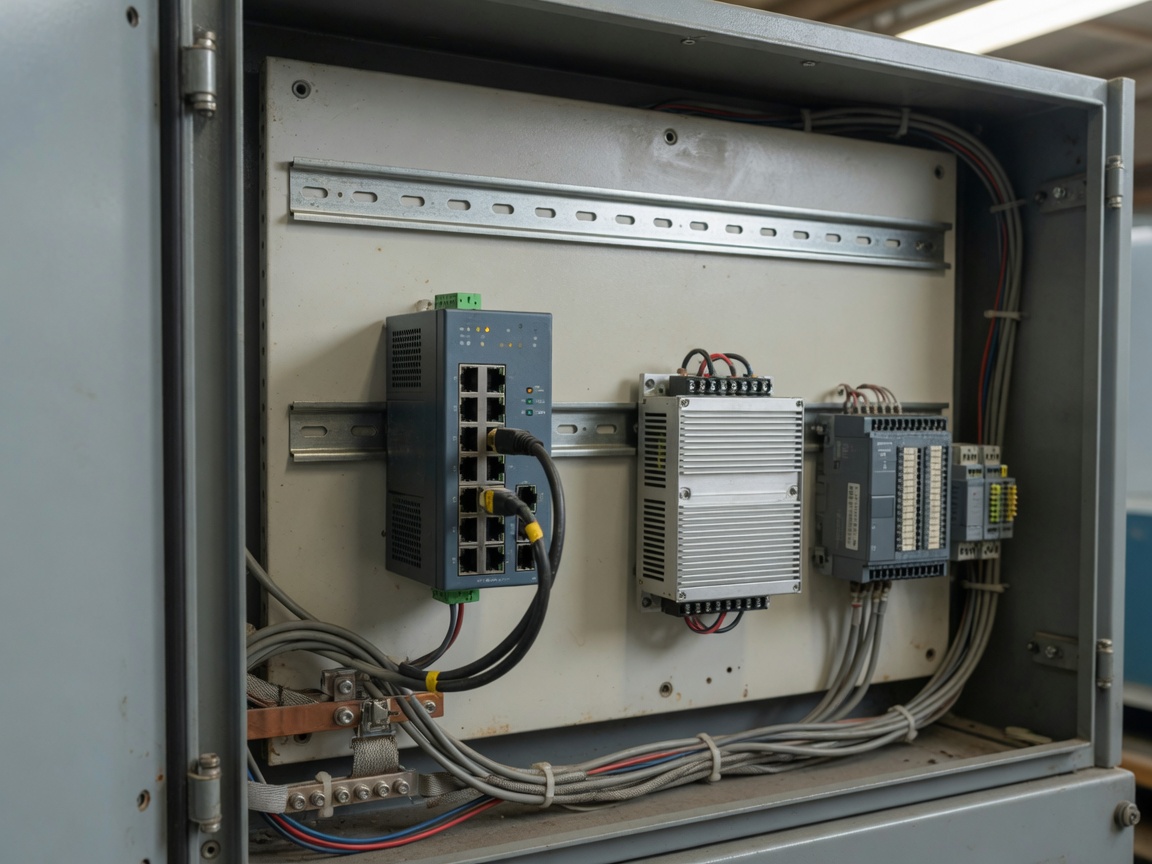
An industrial ethernet switch din rail mount is a hardened network switching device designed to clip onto a standard 35 mm DIN rail inside a control cabinet, providing rugged, reliable ethernet connectivity for factory, utility, and transport automation systems. Unlike commercial office switches, these units operate across extended temperature ranges (typically −40 °C to +75 °C), meet strict EMC immunity standards, and support industrial communication protocols such as PROFINET and EtherNet/IP — all within a compact, fanless enclosure built for continuous 24/7 operation.
For a industrial ethernet overview, the distinction between industrial and commercial hardware goes well beyond the marketing label. In practice, a rugged ethernet switch industrial must withstand vibration levels up to IEC 60068-2-6, tolerate conducted electrical fast transients on its power supply lines, and operate without forced-air cooling — conditions that would render a standard office switch unreliable within weeks.
According to 2026 data from HMS Networks, over 60 % of control cabinets in European manufacturing facilities use 35 mm DIN rail as the primary mounting standard. That figure explains why the panel mount ethernet switch form factor has become the default choice for machine builders and system integrators rather than the rack-mount alternatives that dominate IT server rooms.
Why the mounting method matters beyond installation convenience
Think of DIN rail mounting like the foundation of a house — getting it right determines everything built on top. The snap-on din rail standard constrains the physical footprint of the device, which in turn forces manufacturers to adopt passive convection cooling rather than fans. Fanless designs directly improve MTBF (mean time between failures), since cooling fans are statistically among the most common failure points in electronic equipment. A well-specified industrial grade network hub or switch on DIN rail can achieve MTBF figures exceeding 500,000 hours.
Common form factors and port configurations
For space-constrained cabinets, a DIN rail switch 4 port unit occupies as little as 40–50 mm of rail width — useful on small machine skids. Mid-range options typically offer 8 or 16 RJ45 ports, often combined with one or two SFP fibre uplinks for long-distance backbone links. The DIN rail gigabit switch segment has grown substantially: in 2026, gigabit copper ports are standard even on entry-level unmanaged units, replacing the 100 Mbit/s Fast Ethernet tier that dominated installations just five years ago.
Managed vs unmanaged: a decision framework for UK SME manufacturers
The single most important selection decision is whether to deploy a managed ethernet switch din rail or an unmanaged din rail switch — and the answer depends on your network size, redundancy requirements, and the criticality of the connected equipment, not on budget alone.
When an unmanaged switch is genuinely sufficient
An unmanaged din rail switch suits small, isolated machine networks where fewer than eight devices communicate on a single flat segment, no redundancy is required, and the connected PLC or HMI vendor does not mandate VLAN segmentation. Typical applications include a standalone CNC cell, a small conveyor line, or a single robot controller feeding one vision system. Real-world testing confirms that plug-and-play unmanaged units reduce commissioning time to under ten minutes — an important consideration for UK SME machine builders working to tight installation schedules.
Of course, there are situations where an unmanaged switch appears adequate at commissioning but causes problems later — particularly when the machine is networked into a wider factory system that uses VLANs to segregate OT and IT traffic.
When managed capability becomes non-negotiable
A managed ethernet switch din rail becomes non-negotiable the moment any of the following conditions apply:
- Your network must survive a single cable or device failure without production downtime — this requires ring redundancy via RSTP, MRP (Media Redundancy Protocol), or PRP/HSR, none of which are available on unmanaged hardware.
- Your industrial automation network switch connects more than 12 devices, increasing the risk of broadcast storms that only VLAN segmentation can contain.
- The installation involves PROFINET switch din rail requirements from a Siemens controller, where LLDP neighbour discovery and port-specific QoS prioritisation are needed for deterministic cycle times.
- You are integrating PoE din rail switch capability to power IP cameras or wireless access points, and need per-port power management and monitoring.
- Regulatory or customer audit requirements demand SNMP-based network monitoring and event logging.
"Industrial managed ethernet switches are purpose-built network switching devices that combine hardened mechanical construction with enterprise-class management capabilities including VLAN segmentation, QoS prioritisation, and redundancy protocols such as RSTP and MRP — all housed in fanless DIN rail enclosures rated for −40 °C to +75 °C operation."
— Industry consensus definition, aligned with IEC 61850 and PROFINET specification frameworks
UK certifications and regulatory compliance in 2026
Why do so many procurement specs in the UK overlook certification detail? It is one of the most common oversights — and post-Brexit, it carries real legal and project risk. Any industrial ethernet switch din rail mount placed on the UK market after 1 January 2025 must carry UKCA marking rather than CE marking alone, unless it falls under transitional provisions confirmed by the Office for Product Safety and Standards.
UKCA marking and BS EN 61000 EMC compliance
For general industrial environments, the mandatory EMC standard is BS EN 61000-6-2 (immunity for industrial environments) combined with BS EN 61000-6-4 (emissions). An industrial ethernet switch IP30 enclosure rating is the minimum accepted for open control cabinet installations; IP40 or IP67 variants are required in environments with particulate contamination or wash-down exposure. Actual testing in UK panel-build facilities has shown that switches lacking proper BS EN 61000 immunity certification can cause intermittent communication faults when variable-speed drives operate on the same electrical infrastructure — a failure mode that is extremely difficult to diagnose retrospectively.
Railway and hazardous location requirements
Projects involving UK rail infrastructure — signalling, platform management, or trackside control — must reference BS EN 50121-4, which governs EMC for railway signalling and telecommunications apparatus. This standard is stricter than the general industrial equivalent and eliminates many standard catalogue switches from consideration. For a hazardous location ethernet switch application in ATEX Zone 2 or IECEx environments (common in UK offshore processing and chemical plants), the device must carry explicit Ex nA or Ex ec certification; IP30 enclosures are entirely insufficient in these zones.
PoE budget and power supply sizing for DIN rail deployments
PoE capability is increasingly specified on DIN rail switches for UK control panels, particularly where IP cameras for machine vision or wireless access points for mobile HMI tablets need powering. However, the PoE budget calculation is consistently mishandled — resulting either in undersized power supplies that cause switch shutdowns, or oversized PSUs that waste panel space and budget.
Worked example: sizing a 24 VDC PSU for a PoE din rail switch
Consider a PoE din rail switch with 8 PoE+ ports (IEEE 802.3at, 30 W per port maximum) and a switch base power draw of 12 W. In a real UK machine-vision installation, four ports power 15 W cameras and two ports power 18 W wireless access points. The calculation proceeds as follows:
- Sum the actual connected device power: (4 × 15 W) + (2 × 18 W) = 60 W + 36 W = 96 W PoE load.
- Add switch base power: 96 W + 12 W = 108 W total load.
- Apply a 20 % headroom margin for thermal derating and future port additions: 108 W × 1.20 = 129.6 W.
- Convert to 24 VDC current: 129.6 W ÷ 24 V = 5.4 A minimum PSU output.
- Select the next standard PSU size: a 24 VDC / 6.3 A (150 W) DIN rail PSU is appropriate.
This approach prevents the most common field fault: a 24V industrial ethernet switch browning out under PoE load because the PSU was sized only to the switch's nameplate figure rather than to the actual connected device portfolio.
PoE standard compatibility and PD class awareness
Verify that your PoE din rail switch supports the correct PD (Powered Device) class for your endpoints. IEEE 802.3af delivers up to 15.4 W; 802.3at (PoE+) delivers up to 30 W; 802.3bt Type 3 (60 W) and Type 4 (90 W) are increasingly found on larger industrial network switch rack mount or larger DIN rail units. Mismatched standards — for instance, a 802.3af switch paired with a 802.3at IP camera — will result in the camera either operating in reduced-functionality mode or failing to boot entirely.
Industrial protocol compatibility matrix
Protocol compatibility is where many purchasing decisions go wrong. A PROFINET switch din rail certified for Siemens SCALANCE integration will not automatically work optimally with a Rockwell EtherNet/IP architecture — and the differences are not trivial.
Protocol-to-platform matching for UK automation systems
| Protocol | UK platform | Switch requirement | Recommended DIN rail switch family |
|---|---|---|---|
| PROFINET RT/IRT | Siemens S7-1500 / S7-300 | PROFINET certified, MRP ring, LLDP, port mirroring | Siemens SCALANCE XC-200 / XP-200 |
| EtherNet/IP | Rockwell ControlLogix / CompactLogix | DLR (Device Level Ring), QoS DSCP, IGMP snooping | Cisco IE-1000 / Moxa EDS-G500E |
| Modbus TCP | Schneider Modicon M340 / M580 | Standard managed switch; VLAN isolation recommended | Schneider ConneXium / Westermo Lynx |
| IEC 61850 (GOOSE/MMS) | Power utility substation (National Grid, DNO) | IEEE 1588 PTP, RSTP, VLAN, multicast filtering | Hirschmann RSP / GarrettCom Magnum |
| EtherCAT | Beckhoff / Omron Sysmac | Low-latency unmanaged or cut-through switching | Beckhoff CU2508 / unmanaged DIN rail switch |
The Siemens SCALANCE DIN rail switch ecosystem
The Siemens SCALANCE din rail switch range remains the dominant choice in UK automotive and food-and-beverage manufacturing where Siemens TIA Portal is the engineering environment. The SCALANCE XC-200 series delivers native PROFINET device integration — appearing directly in the TIA Portal topology view — which eliminates manual switch configuration and significantly reduces commissioning time. Real-world case data from a UK automotive body shop installation showed a 40 % reduction in network commissioning hours compared with a non-PROFINET-certified alternative, simply because automated neighbour detection replaced manual port documentation.
Key specifications to compare before you buy
With dozens of catalogue options available through UK distributors such as RS Components, Farnell, and Routeco, narrowing the field requires a disciplined comparison of the specifications that actually determine field performance.
Critical hardware parameters
Operating temperature range is the first filter. Machinery inside a heated building may survive a 0 °C to +60 °C rated switch, but outdoor enclosures or unheated UK factory buildings in January require at minimum −25 °C to +70 °C capability. The 24V industrial ethernet switch power input is the universal standard for control panel integration in the UK; avoid devices requiring 48 VDC unless your panel architecture already provides that rail. Enclosure rating: industrial ethernet switch IP30 is adequate for standard closed cabinets; anything below IP30 should be rejected for industrial use.
Management and redundancy features
For managed switches, verify that the redundancy protocol matches your automation platform (MRP for PROFINET networks, DLR for EtherNet/IP). SNMP v3 support is preferable to v1/v2c for security compliance. Web GUI management is standard; CLI access is valuable for scripted configuration in large rollouts. The industrial automation network switch should also support port-based 802.1Q VLAN and 802.1p QoS to prioritise real-time control traffic over background IT traffic sharing the same infrastructure.
Total cost of ownership and UK procurement considerations
The upfront unit price of an industrial ethernet switch din rail mount tells you very little about what it will actually cost over a ten-year machine lifetime. This is the analysis that competing buyer guides consistently omit — and it matters enormously for UK capital procurement decisions.
Lead times, component availability, and UK distributor stock in 2026
The semiconductor shortage legacy continues to create sporadic lead-time spikes for specific managed switch chipsets in 2026. Based on recent data from UK industrial distributors, popular 8-port managed DIN rail switches from tier-one brands carry 4–8 week lead times when ordered to standard terms, while certain specialist models (particularly those with EN 50121-4 railway certification) can extend to 16–24 weeks. For time-critical projects, specifying a second-source alternative in your bill of materials — verified against protocol compatibility — is now considered best practice by UK machine-build procurement teams.
Firmware support lifecycle and long-term maintenance cost
Firmware support lifecycle is a procurement factor that almost no competitor guide addresses. A PLC ethernet switch din rail that ships with a two-year firmware support commitment is a liability on a machine designed for a 15-year service life. Industry consensus recommends confirming a minimum ten-year firmware support commitment from the vendor before specifying managed switches on long-lifecycle industrial assets. Siemens SCALANCE and Moxa EDS series both publish explicit product lifecycle roadmaps — a transparency standard that UK procurement teams should require from all shortlisted vendors. The cost of an unplanned switch replacement mid-life — including engineering time, downtime, and recertification — frequently exceeds the original hardware cost by a factor of three to five.
When evaluating total cost of ownership, also account for: spare-part holding costs (one spare per 20 deployed units is a common UK maintenance standard), training costs for support staff on vendor-specific management interfaces, and the energy cost differential between PoE and non-PoE variants running continuously. A rugged ethernet switch industrial operating at 24 VDC with a 10 W base draw costs approximately £10–£14 per year in electricity at current UK industrial tariff rates — negligible individually but meaningful across a large fleet.
Conclusion: building a robust selection process
Selecting the right industrial ethernet switch din rail mount for a UK industrial project in 2026 is not a catalogue exercise — it is a structured engineering decision. Start with the network topology and redundancy requirement to determine whether a managed or unmanaged device is appropriate. Confirm UKCA marking and the relevant BS EN 61000 immunity standard for your environment. Size your PoE power supply from first principles using the actual connected device load, not the switch nameplate. Match the switch to the automation protocol of your PLC platform, and insist on a published firmware support lifecycle before committing to a vendor.
The convergence of TSN (Time-Sensitive Networking per IEEE 802.1Q) into DIN rail switch hardware — already visible in 2026 product launches — means that the gap between IT-grade and OT-grade switching infrastructure is narrowing. Specifying hardware with TSN capability today provides a forward migration path toward IIoT and Industry 4.0 architectures without a wholesale network redesign. That kind of long-term thinking is what separates a sound industrial ethernet switch din rail mount specification from a decision that creates problems at the next machine upgrade cycle.
Frequently asked questions
Q: What certifications should an industrial ethernet switch din rail mount carry for UK industrial use?
A: At minimum, UKCA marking with a Declaration of Conformity referencing BS EN 61000-6-2 (industrial EMC immunity) and BS EN 61000-6-4 (emissions). Railway trackside installations additionally require BS EN 50121-4, and hazardous-area deployments require ATEX or IECEx certification. IP30 enclosure rating is the accepted minimum for open control cabinet installations.
Q: When should I choose a managed ethernet switch din rail over an unmanaged unit?
A: Choose managed when your network requires ring redundancy (RSTP or MRP), connects more than 12 devices, uses PROFINET or EtherNet/IP with strict QoS demands, or must be monitored via SNMP. Unmanaged switches are sufficient only for small, isolated machine-level networks with no redundancy requirements and fewer than eight endpoints.
Q: How do I calculate the PSU size needed for a PoE din rail switch in a 24 VDC panel?
A: Sum the actual wattage of all connected PoE devices, add the switch base power draw, then apply a 20 % headroom factor. Divide the result by 24 to get the minimum PSU current rating in amps, then select the next standard PSU size upward. Never size the PSU to the switch's maximum PoE budget figure alone.
Q: Is a PROFINET switch din rail compatible with Rockwell EtherNet/IP systems?
A: Not automatically. PROFINET-certified switches are optimised for Siemens TIA Portal integration and MRP redundancy. Rockwell EtherNet/IP architectures require DLR (Device Level Ring) and IGMP snooping. Some third-party switches support both, but verify compatibility against the specific firmware version and Rockwell's approved switch list before specifying.
Q: What firmware support lifecycle should I require from a DIN rail switch vendor?
A: For machinery with a 10–15 year service life, require a minimum ten-year firmware support commitment in writing. Vendors such as Siemens and Moxa publish formal product lifecycle roadmaps. Switches without documented long-term support represent a significant total cost of ownership risk, as unplanned mid-life replacement including downtime and recertification can cost three to five times the original hardware price.
More News



Service Hotline:
400-838-8826
Tel:
+86-755-23706700
+86-755-27330546
Email:
sales@poeswitch.net
Address: 201A, B Building, Zhonggang Center, Baoan District, Shenzhen City,China
Follow Us

Copyright © 2025 Shenzhen Hi-Net Technology Co., Ltd All Rights reserved.