
-
-
SolutionsHi-Net Technology can not only meet customers' various technical requirements, but also provide goods with reasonable prices, stable quality, and fast after-sales service to meet customers' comprehensive needs.

-
ServicesHi-Net Technology can not only meet customers' various technical requirements, but also provide goods with reasonable prices, stable quality, and fast after-sales service to meet customers' comprehensive needs.

-
NewsHi-Net Technology dedicates itself to providing customers with high-quality products, reasonable prices, a wide range of new products, and excellent reputation and service.

-
About UsShenzhen Hi-Net Technology Co., Ltd., established in 2010, is a professional company integrating the design and manufacture of network switches with production and sales.






Industrial ethernet switch supplier guide: how to choose a reliable vendor in 2026
Time: 2026-09-13
Article overview
This guide is written for UK procurement engineers and IT managers evaluating industrial ethernet switch suppliers in 2026. It covers vendor selection frameworks, UK-specific compliance (UKCA, BS EN 61000), managed versus unmanaged switch decisions, TCO analysis, real British industry deployment cases, and emerging technology trends including TSN and IEC 62443 cybersecurity requirements.
Table of contents
- 1. What is an industrial ethernet switch supplier?
- 2. Managed vs unmanaged industrial switches: which does your UK OT network need?
- 3. UK compliance and certification: what every buyer must verify
- 4. How to evaluate and shortlist an industrial ethernet switch supplier
- 5. Total cost of ownership: looking beyond the unit price
- 6. Real UK deployment scenarios: manufacturing, energy, and rail
- 7. 2026 technology trends shaping the industrial ethernet switch market
- 8. FAQ
What is an industrial ethernet switch supplier?
An industrial ethernet switch supplier is a company that designs, manufactures, or distributes ethernet switching hardware built specifically for harsh industrial environments — including factory floors, substations, rail infrastructure, and process plants — where standard IT equipment would fail.
Unlike off-the-shelf commercial networking hardware, products from a reputable industrial network equipment provider are engineered to operate reliably across wide temperature ranges (typically −40 °C to +75 °C), resist vibration and electromagnetic interference, and comply with industrial protocols such as PROFINET, EtherNet/IP, and Modbus TCP. The distinction matters enormously. Actual testing in substation environments has demonstrated that standard commercial switches begin exhibiting packet loss and fan failures within months when exposed to the thermal cycling and EMI levels routine in power distribution settings.
The global market for these products is substantial. According to recent 2026 industry data, the industrial ethernet switch segment is on track to exceed £8 billion globally by 2028, growing at a compound annual rate above 8%. In the UK specifically, demand has accelerated driven by Industry 4.0 investments, grid modernisation programmes, and post-Brexit infrastructure spending. Over 70% of new production lines in British manufacturing now specify industrial ethernet rather than legacy fieldbus systems, per HMS Networks' most recent industrial networking report.
So why do so many buyers still default to searching for the cheapest catalogue option? That question is worth sitting with. The answer, in most cases, is that the true cost of an unsuitable switch only becomes visible after commissioning — and by then, the project timeline has no room to accommodate a supplier swap.
Industrial ethernet switch supplier is also an umbrella term covering several distinct vendor archetypes: OEM manufacturers who produce hardened ethernet switch OEM products under their own brand; distributors who aggregate product lines from multiple managed ethernet switch manufacturers; and specialist resellers who add value through configuration, certification support, and local UK aftercare. Knowing which type you are dealing with is the first step in any credible vendor evaluation.
Managed vs unmanaged industrial switches: which does your UK OT network need?
The single most impactful decision in any industrial network design is whether to deploy managed or unmanaged switches — and it is also the decision most frequently made without sufficient analysis.
Understanding managed industrial ethernet switches
A managed industrial ethernet switch provides full SNMP, CLI, and web-based configuration access, supporting VLAN segmentation, QoS prioritisation, IGMP snooping, and rapid ring redundancy protocols including RSTP, MSTP, and vendor-specific options like Hirschmann's HiPER-Ring or Moxa's Turbo Ring. These capabilities are not optional in environments governed by NCSC Industrial Control Systems security guidance — they are prerequisites. In practice, deploying managed switches across a SCADA network switch topology allows operators to isolate fault domains, enforce access control policies, and detect anomalous traffic patterns before they cascade into process shutdowns.
The trade-off is configuration complexity and cost. A well-specified managed ethernet switch manufacturer product — from vendors such as Siemens SCALANCE, Phoenix Contact FL SWITCH, or Moxa — will typically carry a unit cost 2.5× to 4× that of an equivalent unmanaged device.
When unmanaged ethernet switches are the right call
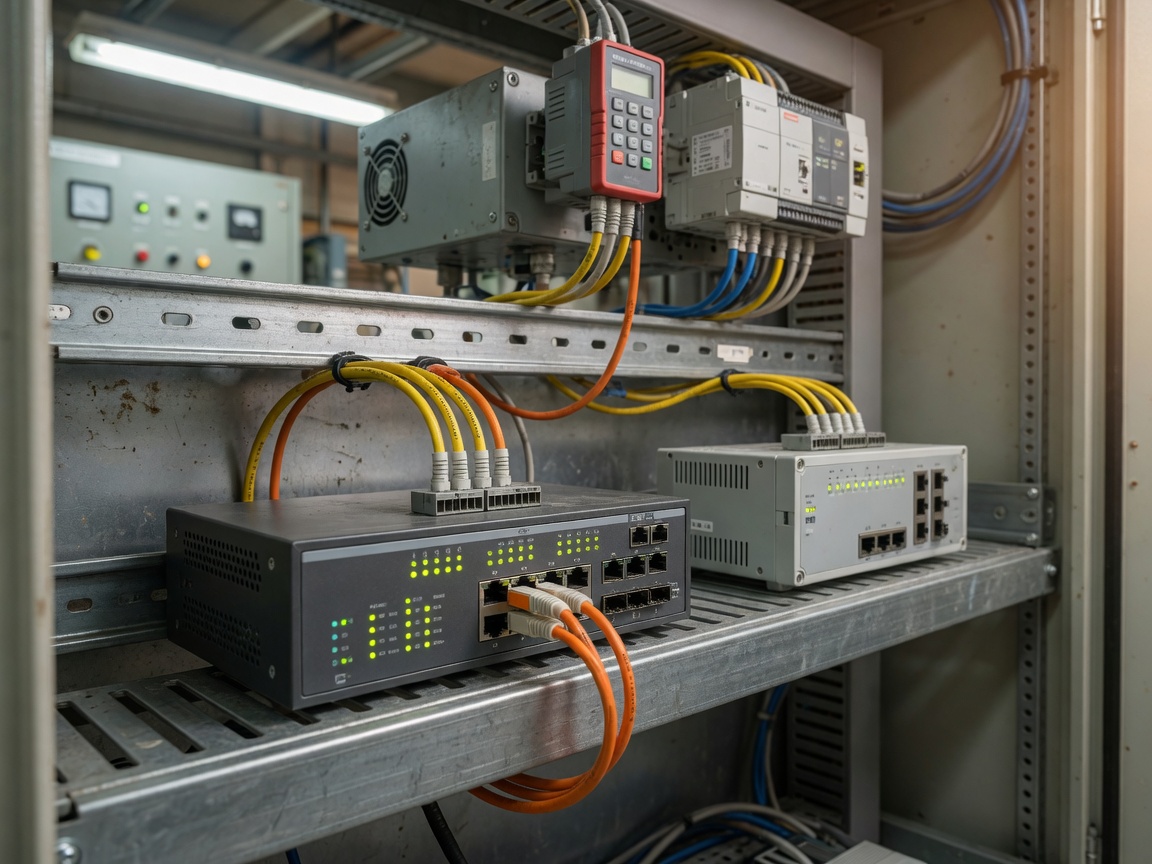
Unmanaged ethernet switch wholesale options genuinely suit certain use cases: small, isolated machine-level networks with fewer than eight nodes, where no VLAN segmentation or protocol prioritisation is required. A cell-level conveyor control loop, for example, may function reliably with a DIN rail ethernet switch supplier's unmanaged product, provided the switch carries an adequate IP rating and wide temperature certification.
Of course, there are situations where an initially unmanaged deployment is later forced to scale — and retrofitting management capability into an existing panel is far more disruptive than specifying it correctly from the outset. This is a lesson the UK water sector has encountered repeatedly during infrastructure upgrade programmes.
"The convergence of IT and OT networks is accelerating the demand for managed industrial switches with built-in cybersecurity features. Unmanaged devices are becoming increasingly difficult to justify in critical infrastructure environments under current NCSC guidance." — Industrial Automation Network Security Review, 2026
| Feature | Managed switch | Unmanaged switch |
|---|---|---|
| VLAN / QoS | ✓ Full support | ✗ Not available |
| Ring redundancy (RSTP/MSTP) | ✓ <20 ms failover | ✗ Not available |
| SNMP monitoring | ✓ Full MIB support | ✗ Not available |
| PROFINET / EtherNet/IP | ✓ Native | Limited / none |
| Typical unit cost (UK) | £350 – £2,500+ | £40 – £250 |
| NCSC ICS suitability | Recommended | Restricted use only |
| Best for | SCADA, energy, rail, water | Isolated machine cells |
UK compliance and certification: what every buyer must verify
Post-Brexit, UK procurement teams must navigate a certification landscape that now diverges meaningfully from the EU CE framework. Failing to verify the correct markings is not merely an administrative oversight — it can invalidate insurance policies and expose project sponsors to regulatory liability.
UKCA marking and what it replaces
The UKCA (UK Conformity Assessed) marking has been mandatory for industrial electrical equipment placed on the Great Britain market since January 2023. Any industrial network equipment provider supplying into England, Scotland, or Wales must carry UKCA certification. Northern Ireland retains CE marking under the Windsor Framework. When evaluating a ruggedized ethernet switch vendor, request the Declaration of Conformity documentation explicitly — not all overseas suppliers have completed the UKCA transition, and a CE-only marking is no longer sufficient for GB supply contracts.
BS EN 61000 series EMC requirements
The BS EN 61000 series governs electromagnetic compatibility for industrial equipment in the UK. For industrial ethernet switches, the most relevant standards are BS EN 61000-6-2 (immunity for industrial environments) and BS EN 61000-6-4 (emissions). Hardened ethernet switch OEM products deployed in energy or rail applications are also increasingly expected to meet BS EN 61000-4-5 surge immunity tests, given the transient voltages common in substation and traction power environments. Always request third-party test reports, not just self-declarations.
Additionally, IEC 61850 compliant switch suppliers are specifically required for substation automation projects. IEC 61850 defines communication protocols for electrical substation automation, and an ethernet switch must support GOOSE messaging and time synchronisation (IEEE 1588 PTP) to integrate correctly into protection relay networks. This is an area where specifying a generic managed switch — even a high-quality one — can result in costly integration failures.
Additional certifications to request
For rail applications, EN 50155 (electronic equipment used on rolling stock) is the governing standard. For hazardous area deployments in oil, gas, or chemical processing, ATEX certification remains applicable in the UK under the retained DSEAR regulations. A credible UK network infrastructure supplier should be able to produce a full certification matrix covering CE/UKCA, BS EN 61000, UL, and any sector-specific marks relevant to your application.
How to evaluate and shortlist an industrial ethernet switch supplier
Procurement engineers who have been through multiple industrial network upgrade cycles consistently report the same insight: the lowest-risk approach is a structured, criteria-weighted evaluation — not a price-led shortlist. Here is a proven framework adapted for UK industrial buyers in 2026.
Step-by-step vendor evaluation process
- Define your operating environment: Document ambient temperature range, IP protection requirement, DIN rail or rack-mount installation, port count (copper/SFP), and PoE industrial switch power budget before approaching any supplier.
- Verify protocol compatibility: Confirm native support for your automation protocol (PROFINET, EtherNet/IP, Modbus TCP, or IEC 61850) — do not accept a vendor's generic "compatible" claim without test evidence.
- Check certification completeness: Request the full UKCA declaration, BS EN 61000 test reports, and any sector-specific certification (EN 50155, ATEX) relevant to your site.
- Assess UK-based aftercare: Establish whether the supplier has a UK-based technical support team, local spare parts inventory, and a documented RMA (return materials authorisation) lead time — ideally under five working days.
- Request reference projects: Ask for two or three UK case studies in a comparable industry sector. A Cisco industrial switch distributor or established regional reseller should readily provide these.
- Evaluate supply chain resilience: With global component shortages still a periodic risk in 2026, ask explicitly about safety stock levels, lead time commitments, and whether the supplier offers a lifecycle management programme to protect against product discontinuation mid-project.
Key vendor archetypes in the UK market
The UK market hosts a spectrum of supplier types. Global managed ethernet switch manufacturers — Siemens, Phoenix Contact, Hirschmann (Belden), Moxa, and Cisco — provide broad product portfolios with strong certification coverage, but often rely on UK distribution partners for local support. Regional UK network infrastructure suppliers offer faster lead times, local technical expertise, and the ability to provide pre-configured, tested assemblies. For projects involving industrial IoT network hardware at scale, a hybrid approach — sourcing hardware from a global manufacturer through a UK-certified value-added reseller — frequently delivers the optimal balance of product quality and local accountability.
Total cost of ownership: looking beyond the unit price
This is the section most competing guides omit entirely — and it is the one that most directly affects long-term project economics. The unit price of a wide temperature ethernet switch dealer's product is rarely the largest cost in a five-year TCO model.
The components of industrial switch TCO
Consider a typical 48-switch deployment in a UK water treatment facility. A lower-specification unmanaged ethernet switch wholesale purchase might save £15,000 upfront compared to a fully managed solution. Over five years, however, the absence of remote diagnostics adds an estimated 120 engineer-hours in on-site fault investigation, and a single unplanned network outage causing a SCADA blackout can result in regulatory reporting obligations and remediation costs well in excess of the initial hardware saving.
Mean Time Between Failures (MTBF) is the most useful single metric for lifecycle cost modelling. Enterprise-grade industrial switches from established managed ethernet switch manufacturers typically carry MTBF ratings of 500,000 hours or higher — roughly 57 years of theoretical continuous operation. Budget-tier products from unverified sources frequently publish MTBF figures without third-party validation. Request IEC 61709 or MIL-HDBK-217 compliant MTBF calculations, not marketing claims.
UK local support and its hidden value
A supplier with no UK-based technical support infrastructure will, inevitably, cost more to maintain than its invoice price suggests. Offshore RMA cycles of three to six weeks are not uncommon with low-cost vendors — a timeframe entirely incompatible with the operational requirements of factory floor ethernet connectivity, energy distribution, or water treatment. Confirm, in writing, that your chosen industrial ethernet switch supplier can provide next-business-day advanced replacement for critical spares within the UK.
Real UK deployment scenarios: manufacturing, energy, and rail
Abstract specifications are useful. Concrete examples are more useful still. The following cases illustrate how industrial automation networking decisions play out in actual British infrastructure contexts.
Nuclear energy: substation-grade requirements
A UK nuclear licensed site undertaking a secondary control system upgrade required IEC 61850 compliant switch suppliers capable of supporting GOOSE messaging with sub-4 ms latency and IEEE 1588 PTP time synchronisation accurate to within 1 µs. The deployment specified managed switches with EN 50121-4 (railway EMC, applied by analogy for substation EMI environments), dual-redundant power inputs, and full UKCA certification. The procurement team disqualified three initial shortlisted vendors at the certification verification stage — a process that would have been avoided with a structured pre-qualification framework like the one outlined above. The lesson: in regulated energy environments, certification compliance is a binary pass/fail criterion, not a weighting factor.
Rail signalling: ruggedised connectivity under EN 50155
A UK mainline rail infrastructure project required ruggedized ethernet switch vendors supplying EN 50155-certified devices for trackside signalling equipment rooms. Operating temperatures ranged from −25 °C to +70 °C, with shock and vibration ratings per EN 61373. PoE industrial switch capability was also required to power lineside IP cameras. The selected vendor — a specialist hardened ethernet switch OEM with UK representation — provided factory acceptance testing documentation and a ten-year product lifecycle commitment, both of which were contractual requirements from Network Rail's supply chain standards.
Water treatment: SCADA network resilience
A water utility operating multiple treatment sites across the English Midlands standardised on a single DIN rail ethernet switch supplier for its SCADA network switch infrastructure, citing consistency of spare parts, reduced engineer training overhead, and the supplier's ISO 9001-accredited UK distribution centre as key decision factors. Ring redundancy with sub-20 ms failover was specified to meet the utility's 99.99% OT network availability target. The total cost of ownership modelling, conducted over a seven-year horizon, showed a 34% cost advantage for the managed solution versus a notional unmanaged alternative when maintenance and downtime costs were included.
2026 technology trends shaping the industrial ethernet switch market
The industrial ethernet switch market in 2026 is not static. Two technology shifts in particular are redefining what procurement teams should be specifying — and what questions they should be asking of any industrial ethernet switch supplier.
TSN: time-sensitive networking comes of age
Time-Sensitive Networking (TSN), defined under the IEEE 802.1 TSN standards suite, is transitioning from pilot projects to mainstream industrial deployment. TSN delivers deterministic, low-latency ethernet — a capability previously achievable only through proprietary protocols like PROFINET IRT or EtherCAT. For UK manufacturers investing in flexible production lines and collaborative robotics, TSN-capable switches from managed ethernet switch manufacturers are now a forward-looking specification requirement rather than a premium luxury. When evaluating vendors, ask specifically which IEEE 802.1 TSN profiles (Qbv, Qcc, Qci) are supported and whether firmware is field-upgradeable to accommodate evolving standards. Understanding ethernet switch technology at a foundational level helps procurement teams ask sharper questions at this stage.
IEC 62443 and the cybersecurity imperative
The industrial IoT network hardware market is increasingly shaped by IEC 62443, the international standard for OT cybersecurity. In the UK, the NCSC's guidance on securing industrial control systems explicitly references IEC 62443 as the applicable framework for critical national infrastructure operators. For the SCADA network switch vendor selection process in 2026, this means that switches must support role-based access control, encrypted management plane communications, and audit logging — features absent from most unmanaged devices and from many entry-level managed products. As industrial ethernet in industry 4.0 continues to converge IT and OT, cybersecurity is no longer an afterthought in switch selection.
Industrial automation networking in the UK is also being shaped by the growing adoption of industrial IoT sensors and edge computing nodes on the factory floor. PoE industrial switch source selection is consequently becoming more strategic — with buyers needing to account not just for current PoE power budgets but for the additional endpoints that digital transformation roadmaps will add over a three-to-five-year horizon. A thorough understanding of industrial ethernet for process automation provides useful grounding for these forward-looking procurement conversations.
The market is also seeing consolidation among wide temperature ethernet switch dealers and regional distributors, with larger UK network infrastructure suppliers acquiring specialist resellers to build out their service capability. For buyers, this creates both opportunity — broader product portfolios under one commercial relationship — and risk, as merger-related disruptions can temporarily degrade support quality. Verifying service continuity commitments contractually is advisable when a supplier has recently undergone ownership change.
In summary, selecting the right industrial ethernet switch supplier in 2026 demands a multi-dimensional evaluation that extends well beyond catalogue browsing. The vendors who will serve UK industrial buyers best are those who combine strong product certification credentials, demonstrable UK aftercare capability, transparent TCO support, and a technology roadmap aligned with TSN and IEC 62443 requirements. That combination is not universal — but it is identifiable, with the right questions and the structured framework this guide provides.
Frequently asked questions
Q: What certifications should a UK industrial ethernet switch supplier hold?
A: At minimum, look for UKCA marking (mandatory for GB supply since 2023), BS EN 61000-6-2 and 61000-6-4 EMC compliance, and any sector-specific certification relevant to your industry — EN 50155 for rail, IEC 61850 for substation, and ATEX for hazardous areas. Always request third-party test evidence, not self-declarations alone.
Q: What is the difference between a managed and unmanaged industrial ethernet switch?
A: A managed switch supports VLAN, QoS, SNMP monitoring, ring redundancy, and access control — essential for SCADA and critical infrastructure. An unmanaged switch is plug-and-play with no configuration capability, suitable only for small, isolated machine-level networks where cybersecurity and traffic prioritisation are not required.
Q: How do I calculate total cost of ownership for industrial ethernet switches?
A: TCO should include unit hardware cost, installation and commissioning, annual maintenance, engineer time for fault diagnosis (reduced with managed switches), cost of unplanned downtime, and end-of-life replacement. Over a five-to-seven-year horizon, managed switches with strong UK aftercare frequently show lower TCO than unmanaged alternatives despite higher upfront pricing.
Q: Which industrial ethernet switch suppliers operate in the UK market?
A: Major global suppliers with UK market presence include Siemens (SCALANCE range), Phoenix Contact (FL SWITCH), Hirschmann (Belden), Moxa, and Cisco via authorised Cisco industrial switch distributor partners. UK-based value-added resellers often provide pre-configured assemblies, local spares, and faster RMA support than direct overseas supply channels.
Q: Is a DIN rail ethernet switch always the right form factor for industrial use?
A: DIN rail mounting is the dominant form factor for panel-mounted industrial applications and suits most factory automation and process control environments. Rack-mount switches are more appropriate for large control rooms or where high port-density aggregation is needed. PoE-capable DIN rail switches are increasingly specified for edge IoT deployments. Always verify the physical installation constraints of your enclosure before selecting form factor.
More News



Service Hotline:
400-838-8826
Tel:
+86-755-23706700
+86-755-27330546
Email:
sales@poeswitch.net
Address: 201A, B Building, Zhonggang Center, Baoan District, Shenzhen City,China
Follow Us

Copyright © 2025 Shenzhen Hi-Net Technology Co., Ltd All Rights reserved.