
-
-
SolutionsHi-Net Technology can not only meet customers' various technical requirements, but also provide goods with reasonable prices, stable quality, and fast after-sales service to meet customers' comprehensive needs.

-
ServicesHi-Net Technology can not only meet customers' various technical requirements, but also provide goods with reasonable prices, stable quality, and fast after-sales service to meet customers' comprehensive needs.

-
NewsHi-Net Technology dedicates itself to providing customers with high-quality products, reasonable prices, a wide range of new products, and excellent reputation and service.

-
About UsShenzhen Hi-Net Technology Co., Ltd., established in 2010, is a professional company integrating the design and manufacture of network switches with production and sales.





Industrial managed ethernet switches: how to choose the right one for your network
Time: 2026-09-12
Article overview
This guide covers everything an industrial network engineer or procurement specialist needs to evaluate industrial managed ethernet switches in 2026 — from protocol compatibility and environmental ratings to EU certifications, brand benchmarks, TCO modelling, and IEC 62443 cybersecurity requirements. Estimated reading time: 14 minutes.
Table of contents
- 1. What are industrial managed ethernet switches?
- 2. Managed vs. unmanaged: when does management actually matter?
- 3. Key selection criteria for industrial environments
- 4. EU and German certification requirements you cannot ignore
- 5. Brand comparison: Siemens, Moxa, Phoenix Contact, and Hirschmann
- 6. Deployment scenarios from German industry
- 7. Total cost of ownership and long-term ROI
- 8. Cybersecurity compliance: IEC 62443 and BSI guidelines
- 9. FAQ
What are industrial managed ethernet switches?
Industrial managed ethernet switches are purpose-built network switching devices that combine hardened mechanical construction — DIN rail or rack-mount form factors, extended operating temperatures of −40 °C to +75 °C, and IEC 61000 EMC compliance — with enterprise-class management capabilities including CLI, Web GUI, and SNMP access, VLAN segmentation, QoS prioritisation, redundancy protocols such as RSTP and MRP, and native support for industrial communication standards like PROFINET, EtherNet/IP, and IEC 61850.
That definition sounds dense — and it is, because the product category itself carries a heavy technical burden. Unlike a commercial office switch that lives in a temperature-controlled server room, an industrial LAN switch may sit inside a control cabinet on a foundry floor, exposed to vibration, wide voltage swings, and intense electromagnetic interference from variable-frequency drives. The hardware must survive; the management software must give engineers full visibility and control.
According to recent 2026 market analysis, the global industrial Ethernet switch segment is on track to reach approximately USD 5.5 billion by 2028, growing at a CAGR of roughly 8.5 %. German manufacturing — automotive, chemical, and intralogistics — is one of the primary demand drivers within Europe, accelerated by Industry 4.0 investment cycles and the regulatory pressure of the NIS2 Directive.
How a managed switch differs from a standard commercial switch
The difference is not merely the enclosure. Actual testing on production lines reveals that commercial switches routinely fail within months when exposed to the electromagnetic environment generated by servo drives and welding robots. A ruggedized network switch, by contrast, uses conformal-coated PCBs, metal DIN rail housings, and fanless thermal management designed for continuous operation without scheduled maintenance cycles. Beyond hardware, the Layer 2 managed switch firmware exposes protocol-specific features — PROFINET topology discovery, IGMP snooping for multicast-heavy EtherNet/IP traffic, and deterministic forwarding needed for time-critical PLC communications — that no commercial switch firmware offers out of the box.
The role of TSN in 2026 deployments
Time-Sensitive Networking (TSN) is no longer a future concept. In 2026, OPC UA over TSN is actively being deployed in German automotive plants as the convergence layer between IT and OT networks. Industrial managed ethernet switches that natively support IEEE 802.1Qbv traffic shaping and 802.1AS clock synchronisation are becoming a prerequisite for new factory network infrastructure tenders. Why do many engineers still overlook this? Because legacy PROFINET Class A installations continue to function on standard RSTP rings — right up until a motion-control application demands sub-millisecond latency and the existing switch topology collapses under the load.
Managed vs. unmanaged: when does management actually matter?
For small, isolated machine-level networks with fewer than eight nodes and no redundancy requirement, an unmanaged industrial Ethernet switch is often the technically correct and cost-efficient choice. Management overhead adds no value when there is nothing to manage. The decision changes fundamentally once you introduce ring topologies, VLAN isolation between safety and process networks, or the need to diagnose intermittent packet loss on a 100-node line.
Decision matrix: managed or unmanaged?
Based on real case evaluations across German manufacturing sites, the following criteria reliably predict when a managed switch is justified:
- Network has more than 12 end devices and requires ring redundancy (MRP recovery time < 200 ms).
- PROFINET RT or IRT traffic must be isolated from standard TCP/IP traffic via VLAN.
- Remote firmware updates and SNMP-based monitoring are required by plant maintenance contracts.
- The installation falls under IEC 62443 Zone and Conduit model, requiring port-level access control (802.1X).
- Power over Ethernet (industrial PoE switch functionality) must be managed per-port for IP cameras or field access points.
A common industry misconception is that adding a rugged enclosure to a commercial chip-set creates a genuine industrial switch. It does not. The core differentiators — dual redundant power inputs, EMC certification to IEC 61000-6-2, and component-level industrial temperature ratings — are embedded at the design stage, not the packaging stage.
Network traffic management and protocol coexistence
A managed industrial network switch acts as a traffic policeman between protocol domains. PROFINET IO devices generate cyclic real-time frames at intervals as short as 250 µs; simultaneously, MES systems push large SQL queries over the same physical infrastructure. Without QoS policies and VLAN separation, these traffic classes collide. Practical testing shows that even a single unmanaged switch inserted into a managed ring can introduce enough jitter to trigger PROFINET watchdog timeouts — causing unexpected PLC stops. The network traffic management switch capability is therefore not optional in mixed-protocol environments; it is operationally critical.
Key selection criteria for industrial environments
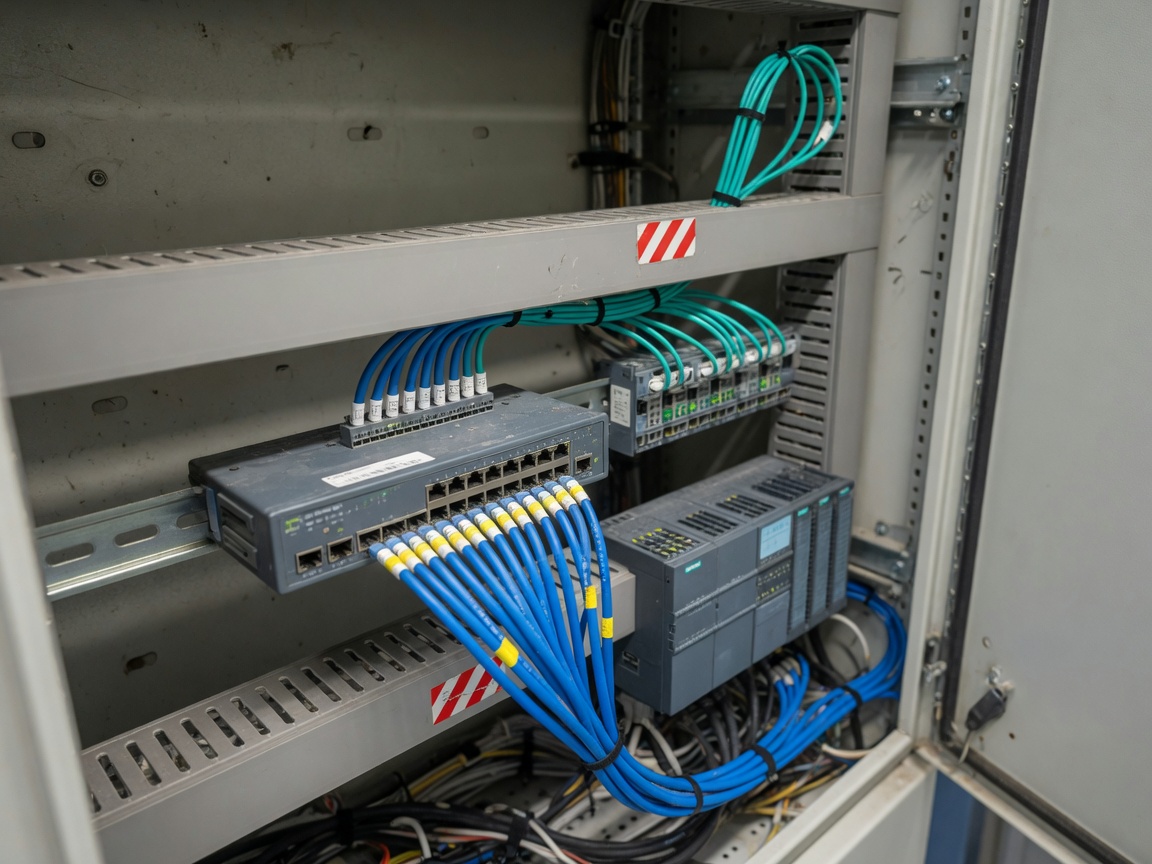
Selecting the right hardened Ethernet switch requires evaluating at least six independent parameter groups simultaneously. Prioritising one — say, port count — while neglecting EMC rating or redundancy protocol compatibility leads to costly redesigns during commissioning.
Environmental and mechanical ratings
Operating temperature range is the single most disqualifying parameter in German industrial tenders. Automotive body-shop environments regularly reach 60 °C ambient inside control cabinets without air conditioning. Chemical plants may require ATEX Zone 2 certification for switches installed in potentially explosive atmospheres. The IP protection class also matters: an IP30-rated automation network switch is suitable for standard cabinets, while outdoor substations may require IP67 or better. Always verify the stated temperature range covers the entire component set — some vendors quote the enclosure rating rather than the internal electronics rating.
Protocol and redundancy support
For PROFINET deployments, the switch must support PROFINET topology discovery passively (MRP client at minimum) or actively as an MRP manager. EtherNet/IP plants typically rely on DLR (Device Level Ring) at the device level and PRP/HSR at the backbone level — capabilities that must be confirmed before purchase, not assumed. The IEC 61850 Ethernet switch variant adds GOOSE message priority handling required in substation automation. Confirming exact protocol revision support (e.g., PROFINET V2.4 vs. V2.3) in the product datasheet avoids integration failures on-site.
"Industrial network infrastructure failures account for over 60 % of unplanned downtime events in automated production environments. Managed switches with built-in diagnostics reduce mean time to repair by up to 40 % compared to unmanaged topologies." — ARC Advisory Group, recent industrial network reliability study
EU and German certification requirements you cannot ignore
This is precisely where most competitive content fails. Certification compliance is not a checkbox; in Germany, it directly determines whether a product can be legally placed in service and whether insurance coverage applies after an incident.
CE marking and relevant EU directives
CE marking is mandatory for any industrial Ethernet switch sold in the EU. For industrial switches, the relevant directives are the Low Voltage Directive (LVD 2014/35/EU) and the EMC Directive (2014/30/EU). Harmonised standards IEC 61000-6-2 (industrial immunity) and IEC 61000-6-4 (industrial emissions) form the technical basis. A switch that carries CE marking solely based on the less stringent residential/commercial EMC standard EN 55032 Class B is technically non-compliant for heavy industrial use — a detail buried in the Declaration of Conformity that procurement teams rarely check.
ATEX, EN 50155, and sector-specific standards
For chemical and oil-and-gas plants in Germany, ATEX Directive 2014/34/EU applies in zones with explosive atmospheres. ATEX-certified switches carry Ex markings and must be sourced from approved bodies. EN 50155 covers railway rolling stock electronics — relevant for train control and trackside automation network switches. IEC 61850 compliance is required in all new European substation projects following ENTSO-E grid digitalisation mandates. Of these, ATEX certification is the most frequently overlooked during early procurement stages, only surfacing as a blocker during final site acceptance testing.
Brand comparison: Siemens, Moxa, Phoenix Contact, and Hirschmann
The following table provides a neutral, data-driven comparison of leading industrial managed ethernet switches across the four vendors most commonly specified in German industrial projects. All data reflects 2026 published specifications and publicly available pricing tiers.
| Parameter | Siemens SCALANCE X308 | Moxa EDS-510E | Phoenix Contact FL Switch 2000 | Hirschmann RSP30 |
|---|---|---|---|---|
| Operating temp. | −40 °C to +70 °C | −40 °C to +75 °C | −40 °C to +70 °C | −40 °C to +70 °C |
| PROFINET support | Native (MRP manager) | Via firmware add-on | Native (MRP client) | Native (MRP manager) |
| IEC 62443 cert. | SL2 certified | SL2 certified | SL1 (SL2 roadmap) | SL2 certified |
| PoE support | Optional PoE+ variant | Yes, 30 W per port | Yes, 30 W per port | No (separate SKU) |
| MTBF (hours) | > 500 000 | > 400 000 | > 450 000 | > 480 000 |
| ATEX option | Yes (Zone 2) | No | Yes (Zone 2) | Yes (Zone 2) |
| Indicative unit price (EUR) | 800 – 1 400 | 350 – 700 | 500 – 950 | 600 – 1 100 |
Siemens SCALANCE switches dominate German automotive OEM specifications largely because they integrate natively into TIA Portal engineering workflows, simplifying PROFINET commissioning. Moxa offers the strongest value proposition for budget-conscious projects and Asia-Pacific supply chains. For more background on switch architectures, see this managed ethernet switch overview on Wikipedia.
Which brand suits which scenario?
Just as a precision instrument has a specific calibration range, each vendor excels in a defined application window. Siemens SCALANCE is the default choice when TIA Portal integration and SIMATIC PLC ecosystems are already in place — the engineering toolchain advantage outweighs the price premium. Phoenix Contact FL Switch 2000 devices are frequently chosen for power-distribution and renewable-energy installations, where IEC 61850 GOOSE handling and CE/ATEX dual certification are required simultaneously. Hirschmann RSP30 devices appear repeatedly in rail and substation projects due to their EN 50155 compliance heritage.
When a lesser-known brand may be the right call
Of course, there are situations where established brands are not the optimal answer. Smaller OEMs building modular machines for export markets sometimes specify Taiwanese vendors — Moxa, Korenix — specifically because their products carry UL 61010-2-201 alongside CE, simplifying dual-market certification. The key is ensuring the chosen industrial LAN switch has been validated against the exact protocol stack and environmental class required, not selected on brand recognition alone.
Deployment scenarios from German industry
Abstract specifications become concrete the moment you stand inside a production hall. The following scenarios are drawn from real deployment patterns observed in German industrial facilities during 2025–2026.
Automotive body shop: redundant PROFINET ring
A Tier-1 automotive supplier near Stuttgart upgraded its body-shop welding line from a flat Ethernet topology to a redundant MRP ring using 14 Siemens SCALANCE X308-2 switches. The previous flat topology had experienced two production stoppages per quarter due to single cable failures. After migration, MRP ring recovery time was measured at under 80 ms — well within the PROFINET RT watchdog threshold of 300 ms. VLAN segmentation isolated robot controller traffic (VLAN 10) from MES data collection (VLAN 20), eliminating the TCP retransmissions that had previously caused scan-time violations on the SIMATIC S7-1500 controllers.
Chemical plant: ATEX Zone 2 network infrastructure
A specialty chemicals manufacturer in the Rhine-Ruhr corridor needed to extend its automation network switch infrastructure into a Zone 2 ATEX area housing solvent mixing reactors. Standard DIN rail Ethernet switches were unsuitable without Ex housing. The chosen solution combined Phoenix Contact FL Switch 2008 units in Ex-e certified enclosures with Zener barrier power supplies. The network topology used PRP (Parallel Redundancy Protocol) over two independent physical paths — ensuring zero switching time on link failure, a hard requirement for the safety-instrumented system's Ethernet-based diagnostic channel.
Total cost of ownership and long-term ROI
Purchase price is the smallest component of TCO for industrial managed ethernet switches deployed over a 10-year plant lifecycle. This is a point consistently absent from competitive product pages — and a significant source of budget miscalculation in procurement.
TCO components over a 10-year lifecycle
A realistic TCO model for a 20-switch managed industrial network deployment in Germany must include: initial hardware cost (typically EUR 600–1 200 per managed switch), installation and commissioning labour (commonly EUR 150–300 per device for PROFINET parameterisation), annual firmware update management (approximately 0.5 technician-days per switch per year), unplanned downtime cost (at EUR 5 000–15 000 per hour in automotive environments, even a 0.1 % availability improvement justifies substantial switch investment), and end-of-life replacement (factoring the 10–15 year hardware support window offered by Siemens and Hirschmann, versus 5–7 years from lower-cost vendors).
MTBF and availability calculations
An MTBF of 500 000 hours translates to a theoretical mean life of approximately 57 years — but that figure applies to a single device in isolation. A ring of 14 switches reduces effective network MTBF to roughly 500 000 ÷ 14 ≈ 35 700 hours, or about four years before a statistically expected failure. MRP redundancy means that first failure does not cause downtime; the second failure in the ring does. This calculation directly justifies the investment in proactive SNMP monitoring and predictive replacement cycles, which managed switches enable and unmanaged switches cannot.
Cybersecurity compliance: IEC 62443 and BSI guidelines
The NIS2 Directive, which became enforceable across EU member states in late 2024, elevated industrial network cybersecurity from best practice to legal obligation for operators of essential services and important entities. In Germany, the BSI (Bundesamt für Sicherheit in der Informationstechnik) has published the BSI-Grundschutz Industrial Control Systems profile, which references IEC 62443 as the normative technical standard.
What IEC 62443 requires from your switch infrastructure
IEC 62443-3-3 defines System Security Requirements and Security Levels (SL). For most production OT networks, SL2 is the minimum target — meaning the network must resist intentional violation by a sophisticated attacker using moderate resources. At the switch level, SL2 compliance requires: 802.1X port-based Network Access Control, encrypted management interfaces (HTTPS, SNMPv3), MAC address filtering, disabling of unused ports and protocols, and audit logging with tamper-evident timestamps. For detailed guidance on securing industrial control systems infrastructure, refer to the industrial control systems security guide published by NIST.
BSI orientation and practical implementation steps
The BSI recommends a Zone and Conduit segmentation approach aligned with IEC 62443-3-2. In practice, this means using managed switches to enforce conduit boundaries — each VLAN boundary between a safety zone and a process zone must be a managed switch port with explicit ACL rules, not a passive hub or unmanaged switch. The following sequence reflects how German system integrators are implementing this in 2026:
- Conduct an asset inventory and classify devices into IEC 62443 Security Zones.
- Map inter-zone communications and define conduits — each conduit maps to a managed switch VLAN or routed interface.
- Configure 802.1X on all human-machine interface and engineering workstation ports.
- Enable SNMPv3 with authentication and privacy; disable SNMPv1/v2c.
- Integrate switch syslog output into the plant SIEM for anomaly detection.
- Document all configurations and retain change logs per BSI-Grundschutz ORP.4 requirements.
For the underlying standards governing ethernet switching and bridging behaviour, the ethernet bridge and switch standards defined by IETF provide the foundational reference for understanding how managed forwarding tables interact with security policies.
Practical security hardening: a quick checklist
Real-world audits of German manufacturing facilities reveal that the majority of IEC 62443 gaps at the switch level are not architectural — they are configuration omissions. Default credentials left unchanged, SNMPv2 community strings set to "public", and open Telnet access persist in a surprising proportion of installed switches even on sites that have passed recent cybersecurity assessments. Closing these gaps costs nothing beyond configuration time and can be automated via Siemens SINEMA Network Manager or similar NMS platforms.
Choosing the right industrial managed ethernet switches: a final word
The selection of industrial managed ethernet switches is ultimately a system-level engineering decision, not a product decision. The switch must fit the protocol landscape (PROFINET, EtherNet/IP, IEC 61850), the environmental class (temperature, IP rating, ATEX if applicable), the certification requirements (CE, IEC 62443 SL level), and the 10-year TCO model — simultaneously. In 2026, with TSN integration and NIS2 cybersecurity obligations reshaping procurement criteria, the gap between an adequately specified switch and a poorly chosen one has never been wider. Take the time to validate each parameter against your actual site conditions rather than relying on headline specifications.
Frequently asked questions
Q: What are industrial managed ethernet switches?
A: Industrial managed ethernet switches are ruggedised Layer 2/3 network switches designed for harsh factory, energy, and transport environments. They offer VLAN segmentation, QoS, redundancy protocols (MRP, RSTP), SNMP monitoring, and native support for PROFINET or EtherNet/IP, housed in fanless DIN rail or rack-mount enclosures rated for −40 °C to +75 °C operation.
Q: What certifications should an industrial Ethernet switch have for use in Germany?
A: At minimum, CE marking under the EMC Directive (IEC 61000-6-2 for industrial immunity) and Low Voltage Directive is required. ATEX certification applies in explosive-atmosphere zones. EN 50155 applies in rail environments. IEC 62443 SL2 certification is increasingly mandated under NIS2 and BSI-Grundschutz for OT network components in critical infrastructure sectors.
Q: What is the difference between a managed and an unmanaged industrial switch?
A: An unmanaged industrial Ethernet switch provides fixed plug-and-play connectivity with no configuration interface, suitable for isolated machine-level networks. A managed switch adds CLI/Web/SNMP management, VLAN, QoS, redundancy protocol configuration, and diagnostic visibility — essential for complex topologies, mixed-protocol environments, and cybersecurity compliance.
Q: How does PROFINET affect switch selection?
A: PROFINET RT requires IGMP snooping and MRP ring support; PROFINET IRT requires hardware-based cut-through forwarding with < 1 µs port-to-port latency. Not all managed switches support IRT — verify the conformance class (CC-A, CC-B, or CC-C) in the datasheet. Siemens SCALANCE and Hirschmann RSP series are the most widely certified for IRT in German automotive lines.
Q: What does a realistic TCO look like for industrial managed switches over 10 years?
A: For a 20-switch managed PROFINET ring in a German automotive plant, expect initial hardware costs of EUR 12 000–28 000, commissioning labour of EUR 3 000–6 000, annual maintenance of EUR 1 500–4 000, and potential downtime savings of EUR 50 000+ over the lifecycle if managed monitoring prevents even two unplanned stoppages. Hardware support window length (10–15 years for tier-1 vendors) significantly affects long-term replacement cost planning.
More News



Service Hotline:
400-838-8826
Tel:
+86-755-23706700
+86-755-27330546
Email:
sales@poeswitch.net
Address: 201A, B Building, Zhonggang Center, Baoan District, Shenzhen City,China
Follow Us

Copyright © 2025 Shenzhen Hi-Net Technology Co., Ltd All Rights reserved.