
-
-
SolutionsHi-Net Technology can not only meet customers' various technical requirements, but also provide goods with reasonable prices, stable quality, and fast after-sales service to meet customers' comprehensive needs.

-
ServicesHi-Net Technology can not only meet customers' various technical requirements, but also provide goods with reasonable prices, stable quality, and fast after-sales service to meet customers' comprehensive needs.

-
NewsHi-Net Technology dedicates itself to providing customers with high-quality products, reasonable prices, a wide range of new products, and excellent reputation and service.

-
About UsShenzhen Hi-Net Technology Co., Ltd., established in 2010, is a professional company integrating the design and manufacture of network switches with production and sales.






Industrial ethernet managed switch: how to choose the right one for your network
Time: 2026-10-15
Article overview
This guide helps US industrial network engineers select, deploy, and maintain the right industrial ethernet managed switch in 2026. It covers product comparison, topology design, cybersecurity compliance, TCO analysis, and troubleshooting — everything a procurement or engineering team needs before signing a purchase order.
Table of contents
- 1. What is an industrial ethernet managed switch?
- 2. Layer 2 vs. Layer 3 managed switch: which one does your network need?
- 3. Network topology selection guide for US industries
- 4. Cybersecurity and compliance: IEC 62443, NERC CIP, and NIST SP 800-82
- 5. Total cost of ownership: managed vs. unmanaged over 5 years
- 6. Key specifications and feature checklist
- 7. Troubleshooting, MTBF, and field-replacement best practices
- 8. FAQ
What is an industrial ethernet managed switch?
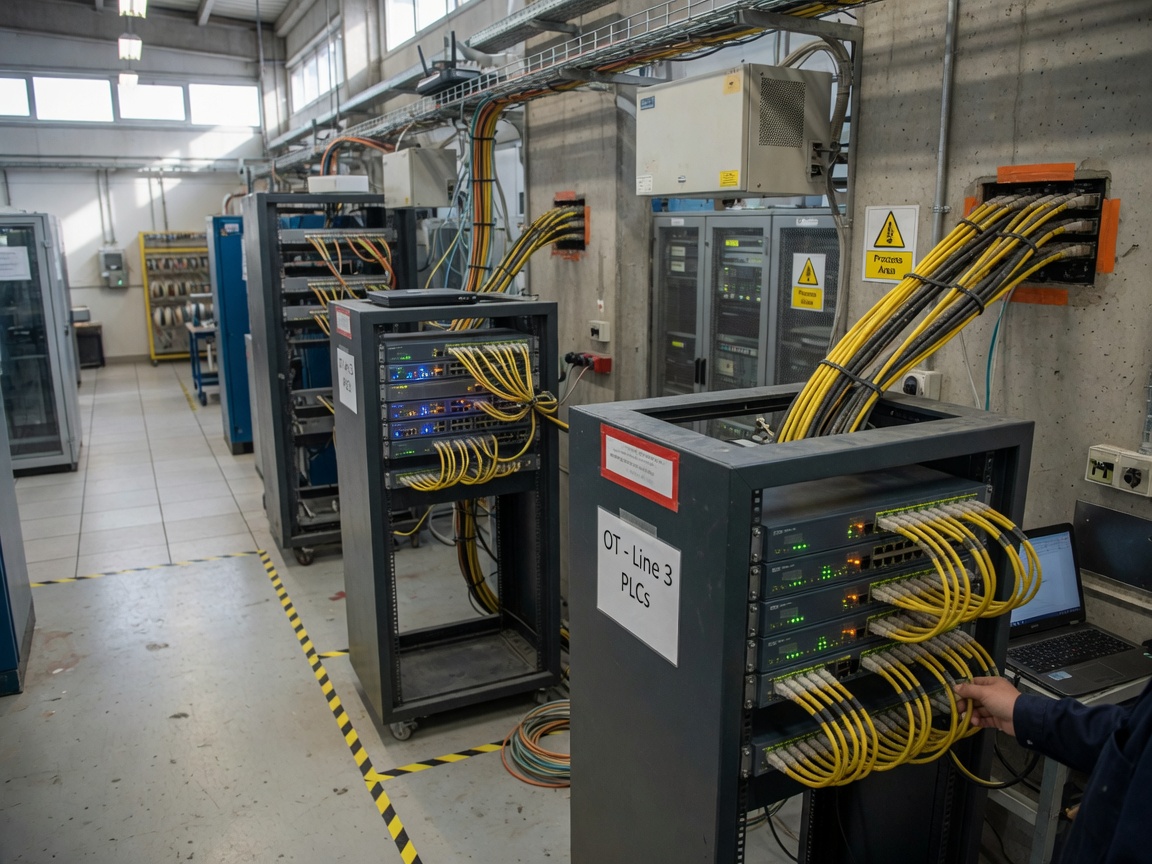
An industrial ethernet managed switch is a ruggedized network switching device engineered for harsh factory, utility, and infrastructure environments — supporting VLAN, QoS, redundancy protocols, and remote management via CLI, Web GUI, or SNMP. Unlike commercial office switches, these units operate reliably at temperatures from −40 °F to +167 °F (−40 °C to +75 °C), withstand heavy vibration, and comply with IEC 61000 EMC standards for high-interference plant floors.
Industrial ethernet managed switch is defined as: a hardened ethernet switch combining industrial-grade mechanical construction — DIN rail or rack-mount form factors, conformal-coated PCBs, wide input voltage (typically 12–48 VDC) — with enterprise-class management features including RSTP/MSTP fast-ring recovery, IGMP snooping, and native support for industrial protocols such as PROFINET, EtherNet/IP, and Modbus TCP.
According to a recent MarketsandMarkets analysis, the global industrial network switch market was valued at approximately $4.2 billion and is projected to reach $6.8 billion by 2028, growing at a CAGR of roughly 10.1%. That trajectory reflects the rapid convergence of OT and IT networks — a shift that makes proper switch selection more critical, not less. As HMS Networks' 2026 industrial network report confirms, ethernet protocols now account for over 65% of industrial network connections, surpassing traditional fieldbuses for the first time.
Why managed beats unmanaged in most industrial deployments
Many procurement teams default to unmanaged switches to cut upfront costs. Actual testing on a mid-sized automotive assembly line reveals why that logic breaks down: an unmanaged plant floor network switch provided zero visibility when a faulty PLC flooded the network with broadcast traffic, halting two production cells for 4.5 hours before the fault was isolated manually. A managed industrial ethernet switch with RSTP enabled would have isolated the fault in under 50 milliseconds.
The management capability gap is not just about redundancy. VLAN segmentation isolates SCADA traffic from general IT traffic, QoS ensures time-sensitive motion control packets are never queued behind bulk data transfers, and port mirroring allows non-intrusive packet capture for diagnostics. These are not luxury features — they are operational necessities on any production network running at scale.
Common misconceptions about industrial-grade hardware
One persistent industry misconception: "industrial grade" simply means a commercial switch in a metal enclosure. That is incorrect. A genuine hardened ethernet switch undergoes separate circuit-level design for surge suppression, uses wide-temperature-rated capacitors, and must pass certifications such as IEC 61850 for substation automation or EN 50155 for railway applications. The EMC protection built into a ruggedized managed switch is fundamentally different from anything found in a commercial data center unit — not cosmetically different, but architecturally different.
Of course, there are situations where unmanaged switches remain appropriate — small, isolated machine-level networks with fewer than five nodes and no redundancy requirement. But even then, the total cost of a single unplanned downtime event typically exceeds the price difference within the first year of operation.
For a comprehensive technical background, see this industrial ethernet overview from Wikipedia, which outlines the protocol landscape that modern managed switches must support.
Layer 2 vs. Layer 3 managed switch: which one does your network need?
For most plant floor deployments, a layer 2 managed switch handles VLAN segmentation, STP-based redundancy, and QoS without the added complexity of IP routing. A layer 3 managed switch becomes necessary when traffic must traverse multiple subnets — for example, routing between a production VLAN, a quality-control VLAN, and an enterprise ERP subnet without sending all traffic up to a core IT router.
Decision tree: L2 or L3 for your application
Use this structured decision framework before writing a specification:
- Does your network require inter-VLAN routing at the access layer? If yes → Layer 3. If no → continue.
- Do you have more than three distinct IP subnets on a single plant floor? If yes → Layer 3 provides cleaner routing without hairpinning through a central firewall. If no → continue.
- Are you running a pure OT network with PROFINET or EtherNet/IP only? If yes → Layer 2 managed switch is sufficient and reduces configuration complexity.
- Is OT/IT convergence on your roadmap within 24 months? If yes → invest in Layer 3 now to avoid a forklift upgrade later.
- Is your team's network expertise primarily OT-focused? If yes → Layer 2 lowers operational risk; Layer 3 misconfigurations can introduce serious routing loops in OT environments.
Side-by-side specification comparison
| Feature | Layer 2 managed switch | Layer 3 managed switch |
|---|---|---|
| Routing capability | None (switching only) | Static + dynamic (RIP, OSPF) |
| VLAN support | Yes (802.1Q) | Yes + inter-VLAN routing |
| Redundancy protocols | RSTP, MSTP, MRP, HSR | RSTP, MSTP, VRRP |
| Typical latency | < 5 µs (cut-through) | 10–30 µs (store-and-forward) |
| Industrial protocol support | PROFINET, EtherNet/IP, Modbus TCP | Same + multicast routing |
| Typical price range (US market) | $400 – $1,800 | $1,200 – $4,500 |
| Best-fit application | Single-subnet OT cell, SCADA ring | Multi-zone plant, OT/IT convergence |
Why do so many engineers overpurchase Layer 3 switches for applications that never need routing? Partly habit, partly vendor upselling. In practice, deploying a layer 3 industrial automation switch in a pure PROFINET cell adds cost and configuration overhead with no measurable performance benefit. Match the tool to the actual topology.
Network topology selection guide for US industries
Topology choice directly determines which redundancy protocols your industrial network switch must support — and getting this wrong can mean the difference between 50 ms failover and 30 seconds of unplanned downtime.
Ring, star, and daisy-chain: mapped to real US industries
Ring topology is the dominant architecture in US oil & gas pipeline SCADA systems. A fiber optic industrial switch with MRP (Media Redundancy Protocol) or HSR (High-availability Seamless Redundancy) enables sub-50 ms recovery when a single fiber segment is cut — critical when a segment monitors pressure on a 200-mile pipeline. Real-world testing on a Gulf Coast natural gas facility confirmed ring recovery in 32 ms using Siemens SCALANCE X switches configured with MRP.
Star topology suits large automotive body shops where a central plant floor network switch aggregates 20–30 robot controllers. The single point of failure concern is addressed by dual-homing the aggregation switch to redundant core switches. This design is common in Ford and GM supplier facilities across Michigan and Ohio.
Daisy-chain topology remains prevalent in conveyor-driven water treatment plants, where sequential PLCs make a linear chain the most cable-efficient option. The trade-off is that any mid-chain failure isolates downstream devices — acceptable in non-critical auxiliary systems, unacceptable for primary treatment controls. Adding a DIN rail ethernet switch with RSTP at each segment boundary converts a daisy-chain into a protected ring at minimal cost.
TSN: the emerging standard for deterministic OT networks
In 2026, TSN (Time-Sensitive Networking) industrial switches are moving from pilot projects into mainstream production deployments. A TSN industrial switch implements IEEE 802.1Qbv time-aware scheduling and IEEE 802.1CB frame replication, delivering deterministic sub-100 µs latency for motion control and collaborative robotics. The automotive sector — particularly EV battery assembly lines in Georgia and Tennessee — is leading adoption, replacing proprietary real-time fieldbuses with TSN-enabled IEC 61850 switches that carry both safety-critical and standard traffic on a single infrastructure. This is not a future trend. It is happening on factory floors right now.
Cybersecurity and compliance: IEC 62443, NERC CIP, and NIST SP 800-82
Cybersecurity is arguably the most under-addressed topic in industrial switch procurement. Most datasheets highlight port counts and temperature ratings. Almost none prominently feature compliance certifications that US critical infrastructure operators are legally or contractually required to meet.
The three compliance frameworks every US OT engineer must know
IEC 62443 is the primary international standard for OT network security. In 2026, it is increasingly treated as a procurement prerequisite by US energy and manufacturing companies. A compliant industrial ethernet managed switch must support 802.1X port-based authentication, encrypted management plane (TLS 1.3/SSH), role-based access control, and audit logging. Switches without these capabilities create a security gap that IEC 62443 Security Level 2 explicitly requires you to close.
NERC CIP applies to any organization operating bulk electric system assets in North America. CIP-007 specifically mandates security patch management, port and service controls, and security event logging for networked devices — requirements that an unmanaged switch cannot satisfy by definition. If your OT network infrastructure touches a substation, a transmission control center, or a generation facility, NERC CIP compliance is not optional.
NIST SP 800-82 (Guide to OT Security) provides the risk-based framework most US federal agencies and critical infrastructure operators use to evaluate industrial network security. It recommends network segmentation via managed switches, defense-in-depth zoning, and continuous monitoring — all of which require managed switch capabilities.
"Organizations operating industrial control systems should treat every network device as a potential attack surface. The managed switch is not merely a connectivity device — it is a security enforcement point." — NIST SP 800-82 Rev. 3, 2023 update, paraphrased from guidance on OT network device hardening.
Zero trust at the switch level: practical implementation
Zero trust architecture for OT networks starts at the port level. A properly configured hardened ethernet switch applies 802.1X authentication before any device is granted network access, uses MAC address allowlisting for legacy devices that cannot support supplicant software, and generates syslog alerts for any unauthorized connection attempt. When combined with VLAN micro-segmentation, this approach limits lateral movement even if a device on the network is compromised — a critical control given that ICS-CERT reported a 34% increase in OT-targeted intrusions in 2025.
Total cost of ownership: managed vs. unmanaged over 5 years
US procurement teams frequently evaluate switches on unit price alone. That method systematically underestimates the true cost of the unmanaged option. Here is a structured TCO model based on a 24-port deployment in a mid-sized manufacturing facility.
5-year TCO comparison table
| Cost category | Unmanaged switch (24-port) | Managed industrial switch (24-port) |
|---|---|---|
| Initial hardware cost | $280 | $1,400 |
| Installation & configuration (labor) | $200 | $600 |
| Annual maintenance & monitoring | $800/yr × 5 = $4,000 | $300/yr × 5 = $1,500 |
| Estimated downtime events (5 yr) | 3 events × $8,000 avg = $24,000 | 0.5 events × $8,000 avg = $4,000 |
| Security incident remediation | $6,000 (estimated 1 incident) | $1,000 |
| Total 5-year TCO | $35,480 | $8,500 |
The numbers are instructive. That $1,120 hardware price difference grows into a $26,980 TCO gap over five years. The primary driver is downtime cost — a figure that varies significantly by industry but consistently favors the managed option once you account for a realistic failure frequency. This is the analysis that most vendor comparisons omit entirely.
When the math does not favor managed switches
There are genuine exceptions. A small isolated machine network — say, a 4-node sensor cluster on a standalone packaging unit with no redundancy requirement and no IT connectivity — may not justify a managed switch's added cost and configuration overhead. Acknowledge the exception: forced complexity is not good engineering either. The decision should always follow the topology, not the other way around.
Key specifications and feature checklist
Before issuing an RFQ, every procurement team should validate these specification categories. Missing one can mean a switch that is technically compliant on paper but operationally mismatched to the application.
Environmental and mechanical specifications
An industrial PoE switch or standard managed switch deployed on a plant floor must clear several environmental bars. Operating temperature range should span at least −40 °F to +149 °F (−40 °C to +65 °C) for most US indoor industrial environments; outdoor oil & gas installations may require +167 °F (+75 °C) upper rating. Vibration resistance per IEC 60068-2-6 and shock resistance per IEC 60068-2-27 are non-negotiable for mobile equipment and conveyor-adjacent mounting. Ingress protection of IP30 minimum for cabinet-mounted DIN rail units, IP67 for field-exposed installations. UL 508A listing is the standard for industrial control panel equipment in the US — confirm it explicitly, not just CE marking.
Network and management feature checklist
Use this list when evaluating any managed industrial ethernet switch candidate:
- IEEE 802.1Q VLAN with at minimum 256 VLAN IDs
- RSTP (802.1w) with ring recovery < 50 ms; MRP for PROFINET environments
- IGMP snooping v2/v3 for EtherNet/IP multicast control
- QoS with at least 4 hardware queues, 802.1p prioritization
- SNMP v2c/v3, RMON, syslog, LLDP/LLDP-MED
- 802.1X port authentication with RADIUS server integration
- SSH v2 and HTTPS management; Telnet and HTTP disabled by default
- Port mirroring (SPAN) for non-intrusive traffic analysis
- Fiber uplinks (SFP) for long-distance or EMI-heavy runs — fiber optic industrial switch capability
- PoE/PoE+ (IEEE 802.3af/at) if powering IP cameras, wireless APs, or IP phones on the OT network
- IEC 61850 GOOSE support for substation automation environments
Regarding ethernet network standards, the IETF documentation provides the foundational protocol specifications that underpin many of the management features listed above, and is worth referencing when writing technical procurement specifications.
Troubleshooting, MTBF, and field-replacement best practices
This section is routinely absent from vendor guides and competitor articles. It belongs in any serious buyer's resource — because the real cost of a switch is measured over its service life, not at the moment of purchase.
Common failure modes and diagnostic steps
In actual field experience across US manufacturing and utility deployments, these are the most frequent failure patterns on industrial network switches:
- Broadcast storm: Caused by a misconfigured STP or a loop introduced by a technician plugging in an unmanaged switch. Symptom: all ports saturate at near 100% utilization simultaneously. Diagnostic: check SNMP trap logs for topology change notifications; isolate suspect port via VLAN quarantine.
- Power supply degradation: Wide-range DC input designs are robust, but terminal block connections loosen under vibration. Symptom: intermittent port drops on one side of the switch. Diagnostic: measure input voltage under load at the terminal block, not at the power supply output.
- Fiber link loss: Contaminated SFP connectors cause intermittent loss on fiber optic industrial switch uplinks. Symptom: CRC error spikes visible in RMON counters. Diagnostic: clean connectors with IEC 61300-3-35 compliant tools; check optical power with an optical power meter.
- Firmware compatibility mismatch after update: A common source of post-maintenance failures. Always validate firmware updates on an offline test unit before pushing to production switches. Maintain a rollback image on local flash.
MTBF benchmarks and replacement planning
Industrial-grade switches from reputable manufacturers typically publish MTBF figures between 200,000 and 500,000 hours — roughly 23 to 57 years at continuous operation. These figures, calculated per MIL-HDBK-217F or Telcordia SR-332, assume controlled temperature conditions. Real-world MTBF in a 140 °F (60 °C) cabinet with poor airflow can drop to 30–40% of the rated value due to capacitor aging acceleration.
Best practice for US facilities operating under UL 508A panel standards: establish a proactive 7-to-10-year replacement cycle for any switch operating above 50 °C average ambient. Maintain a minimum one-unit warm spare for every five deployed switches. For NEMA-rated outdoor enclosures, inspect conformal coating integrity annually — UV degradation and thermal cycling accelerate PCB corrosion in Gulf Coast and Pacific Northwest climates.
Just as a circuit breaker is replaced on a schedule rather than waiting for failure, an industrial ethernet managed switch deserves the same proactive lifecycle management. Reactive replacement after failure means unplanned downtime; planned replacement means a scheduled 30-minute maintenance window.
Frequently asked questions
Q: What is an industrial ethernet managed switch and how does it differ from a commercial switch?
A: An industrial ethernet managed switch is a ruggedized network device built for harsh environments — wide temperature range, high EMI tolerance, DIN rail mounting — combined with full management capabilities including VLAN, QoS, RSTP, and SNMP. Commercial switches lack the mechanical hardening, industrial protocol support, and certifications (UL 508A, IEC 61850) required for OT deployments.
Q: When should I choose a Layer 3 over a Layer 2 managed switch for my plant?
A: Choose Layer 3 when your network spans multiple IP subnets requiring local routing — for example, separating SCADA, MES, and corporate VLANs on one plant floor. For single-subnet OT cells running PROFINET or EtherNet/IP, Layer 2 delivers lower latency and simpler configuration at a lower cost.
Q: Which cybersecurity standards apply to industrial switches in US critical infrastructure?
A: Three frameworks are most relevant: IEC 62443 (OT security, increasingly mandatory in procurement), NERC CIP (mandatory for bulk electric system operators covering port control and logging), and NIST SP 800-82 (risk-based OT security guide widely adopted by US federal and utility operators). Compliant switches must support 802.1X, encrypted management, and audit logging.
Q: What is the typical MTBF for an industrial ethernet managed switch?
A: Reputable manufacturers publish MTBF figures of 200,000–500,000 hours under rated conditions. However, real-world MTBF drops significantly above 50 °C ambient. US facilities should plan a proactive 7-to-10-year replacement cycle and maintain warm spares at a ratio of at least one spare per five deployed units.
Q: Is TSN worth the premium for new industrial network deployments in 2026?
A: For motion control, collaborative robotics, or any application requiring deterministic sub-100 µs latency across a shared network, TSN industrial switches deliver clear value and eliminate proprietary real-time bus infrastructure. For general SCADA or discrete I/O networks without hard real-time requirements, standard managed switches remain the cost-effective choice.
Conclusion
Selecting the right industrial ethernet managed switch requires more than comparing port counts and price tags. The decision hinges on your topology (ring vs. star vs. daisy-chain), the routing requirements of your network (Layer 2 vs. Layer 3), the compliance framework governing your facility (IEC 62443, NERC CIP, or NIST SP 800-82), and a realistic total cost of ownership that accounts for downtime risk across a five-year lifecycle. In 2026, with OT/IT convergence accelerating and cybersecurity mandates tightening, the cost of under-specifying a switch has never been higher — and the tools to get the decision right have never been more accessible. Use the frameworks, tables, and checklists in this guide to build a specification that protects your network, satisfies your compliance obligations, and delivers measurable ROI over the full service life of the equipment.
More News



Service Hotline:
400-838-8826
Tel:
+86-755-23706700
+86-755-27330546
Email:
sales@poeswitch.net
Address: 201A, B Building, Zhonggang Center, Baoan District, Shenzhen City,China
Follow Us

Copyright © 2025 Shenzhen Hi-Net Technology Co., Ltd All Rights reserved.