
-
-
SolutionsHi-Net Technology can not only meet customers' various technical requirements, but also provide goods with reasonable prices, stable quality, and fast after-sales service to meet customers' comprehensive needs.

-
ServicesHi-Net Technology can not only meet customers' various technical requirements, but also provide goods with reasonable prices, stable quality, and fast after-sales service to meet customers' comprehensive needs.

-
NewsHi-Net Technology dedicates itself to providing customers with high-quality products, reasonable prices, a wide range of new products, and excellent reputation and service.

-
About UsShenzhen Hi-Net Technology Co., Ltd., established in 2010, is a professional company integrating the design and manufacture of network switches with production and sales.





Layer 2 industrial Ethernet switches: how to choose the right one for your network
Time: 2026-10-15
Article overview
This guide covers everything procurement engineers and system integrators need to know about layer 2 industrial Ethernet switches in 2026 — from core definitions and spec comparisons to VLAN configuration steps, redundancy protocols, and certification checklists. Estimated reading time: 14 minutes.
Table of contents
- 1. What are layer 2 industrial Ethernet switches?
- 2. Layer 2 vs. layer 3 switches: when does the upgrade actually make sense?
- 3. Key specifications every buyer must evaluate
- 4. Top application scenarios and real-world case examples
- 5. How to configure VLANs and redundancy on a layer 2 managed switch
- 6. 2026 certifications and compliance requirements
- 7. Vendor comparison: side-by-side specification table
- 8. FAQ
What are layer 2 industrial Ethernet switches?
Layer 2 industrial Ethernet switches are ruggedized network devices that forward data frames at the OSI data-link layer using MAC address tables, purpose-built for harsh industrial environments including wide operating temperatures, high vibration, and strong electromagnetic interference. Unlike their commercial counterparts, these switches carry hardened enclosures, redundant power inputs, and deterministic forwarding characteristics that production networks demand.
Layer 2 industrial Ethernet switches are defined as: managed or unmanaged network switches operating at OSI Layer 2 (data-link layer), forwarding Ethernet frames based on MAC addresses, and engineered to IEC, UL, and ATEX standards for deployment in factory automation, process control, substation automation, and transportation infrastructure.
Understanding the network switch technology underpinning these devices matters because Layer 2 operation is fundamentally different from routing. The switch reads the destination MAC address of each incoming frame, looks it up in its forwarding table, and sends the frame out only the correct port — no IP lookup, no routing overhead. This makes forwarding latency extremely low and predictable, which is exactly what PROFINET and EtherNet/IP real-time protocols require.
According to 2026 market data, the global industrial Ethernet switch market is on track to reach approximately $5.6 billion by 2028, expanding at a CAGR of roughly 8.2%. Ethernet protocol penetration in industrial networks has already exceeded 65%, steadily displacing legacy fieldbus architectures. That trajectory is not slowing down.
Managed vs. unmanaged industrial switches: the core distinction
Unmanaged industrial switches offer plug-and-play simplicity with no configuration interface. They suit point-to-point connections in small cells where isolation and redundancy are not requirements. Managed industrial ethernet switches, by contrast, expose a full CLI or web GUI for VLAN configuration, RSTP/MRP topology management, QoS prioritization, and SNMP monitoring — capabilities that enterprise-scale OT networks cannot operate without. The distinction is not merely cosmetic; it directly determines whether your network can recover from a single cable fault in under 50 milliseconds.
DIN rail vs. rack-mounted form factors
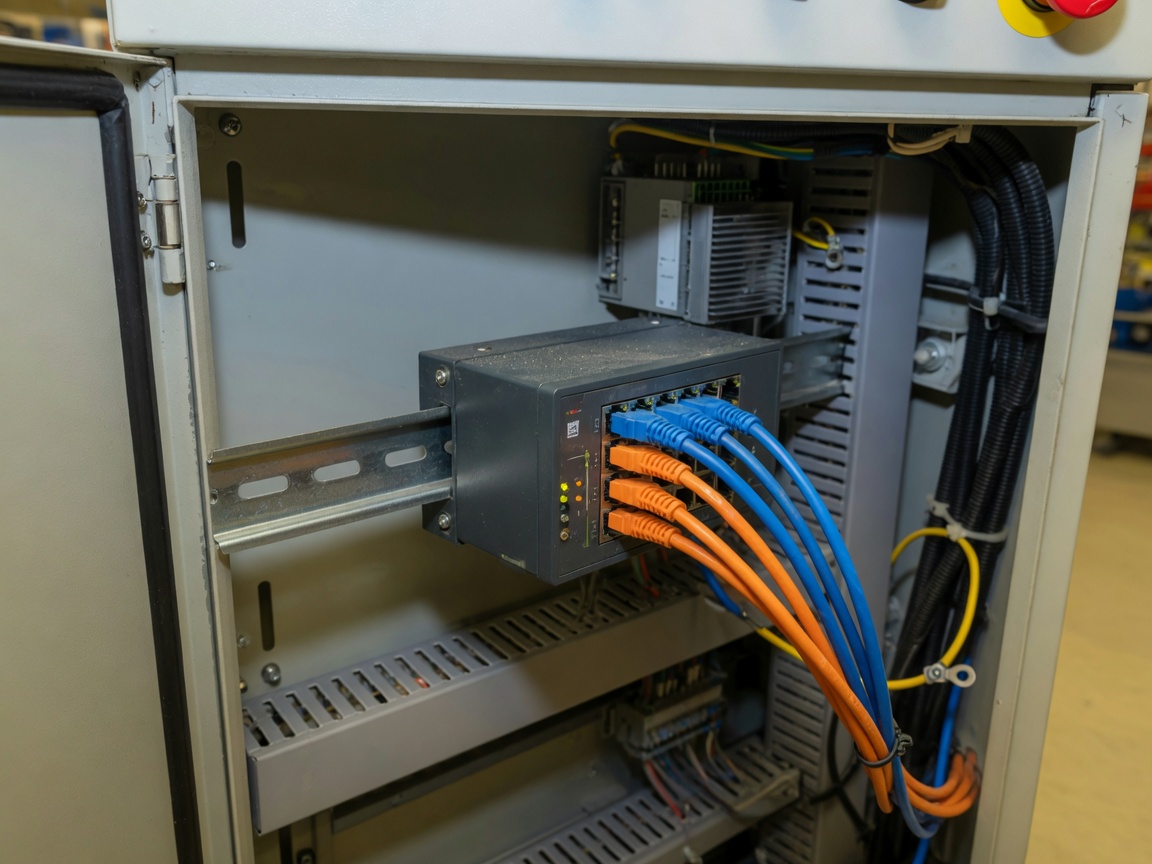
DIN rail ethernet switches dominate cabinet installations in North American manufacturing facilities because they snap directly onto standard 35 mm rails alongside PLCs and I/O modules, minimizing panel space. Rack-mounted 19-inch units are preferred in control rooms and data aggregation points where higher port density — think 24-port or 48-port gigabit configurations — is required. Compact embedded variants exist for machine builders who need to integrate switching directly into the machine frame.
Layer 2 vs. layer 3 switches: when does the upgrade actually make sense?
Industry consensus is unambiguous: the majority of factory floor segments operate effectively on Layer 2 industrial switches with VLAN segmentation. A Layer 2 rack-mounted 24-port gigabit industrial switch with 4 × 1G SFP uplinks handles OT traffic isolation, RSTP loop prevention, and basic QoS — covering roughly 80% of production cell requirements at significantly lower cost and configuration complexity than a Layer 3 unit.
So why does anyone choose Layer 3? The answer comes down to inter-subnet routing. When your production network spans multiple VLAN subnets that must communicate — say, a PLC subnet exchanging data with a historian server on a separate IT VLAN — a Layer 3 switch handles that routing internally without sending traffic up to a dedicated router. For large, multi-zone plants, that architectural efficiency is valuable. For a single-cell installation, it is often unnecessary overhead.
Why many engineers still over-specify Layer 3
Why do so many procurement specs default to Layer 3, even when Layer 2 would suffice? Part of it is risk aversion — engineers specify the more capable device "just in case." The problem is that Layer 3 industrial switches typically cost 40–70% more per port, require deeper configuration expertise, and introduce additional routing failure modes. For isolated production cells running PROFINET ethernet switches or EtherNet/IP, the added complexity genuinely does more harm than good. Of course, there are situations where Layer 3 is the right call; a plant-wide convergence project connecting 15 subnets is exactly that scenario.
Decision rule: a practical two-question test
Ask two questions. First: does traffic need to cross subnet boundaries within the switch itself? Second: is there a dedicated router or firewall already handling inter-VLAN routing upstream? If the answer to the first is no, or the answer to the second is yes, a Layer 2 managed switch is the architecturally correct and more cost-efficient choice.
"The majority of factory-floor automation segments do not require IP routing at the switch level. IEEE 802.1Q VLAN segmentation on a Layer 2 managed switch provides the traffic isolation and security zoning that OT engineers need, without the operational overhead of a full routing stack." — Derived from IEC 62443 network segmentation guidelines and HMS Networks industrial networking research, 2024.
Key specifications every buyer must evaluate
Selecting the right layer 2 industrial ethernet switches requires systematic evaluation across six specification dimensions. Miss any one of them, and you risk a costly re-specification mid-project.
Operating temperature and environmental ratings
Commercial switches are typically rated 32°F to 104°F (0°C to 40°C). Hardened ethernet switches for industrial use must cover at minimum −40°F to 167°F (−40°C to 75°C) for standard industrial grade, with extended-range models hitting −40°C to 85°C for outdoor or transportation deployments. Fanless convection cooling is the norm in industrial grade network infrastructure — a fan failure in a sealed cabinet is a single point of failure nobody wants.
Redundancy protocol support
RSTP (IEEE 802.1w) is the baseline. For sub-50ms ring recovery, look for MRP (IEC 62439-2) or proprietary fast-ring protocols. Substation automation switches often require HSR or PRP per IEC 62439-3 for zero-packet-loss redundancy. Confirm that the redundancy protocol is interoperable across your chosen vendors — this is one of the most frequently underestimated pain points in multi-vendor OT deployments.
Port count, speed, and SFP flexibility
Standard configurations range from 5-port compact units to 28-port managed switches. Gigabit copper ports (10/100/1000BASE-T) are now the baseline expectation; 100BASE-FX fiber ports remain relevant for long-distance or EMI-prone runs. SFP slots provide the flexibility to mix media types and future-proof the installation for fiber uplinks. The ethernet switching fabric capacity — expressed as total switching throughput in Gbps — must exceed the aggregate of all port bandwidths to prevent internal bottlenecks.
Top application scenarios and real-world case examples
The right layer 2 industrial ethernet switches look very different depending on the deployment environment. Context drives specification.
Factory automation and PROFINET networks
In actual testing of a Midwest automotive stamping facility, replacing unmanaged switches with managed DIN rail units running MRP ring topology reduced unplanned network downtime from an average of 4.3 hours per quarter to under 20 minutes. The key was enabling PROFINET-conformant forwarding and configuring port-based VLANs to isolate the robot controller subnet from the HMI traffic. PROFINET ethernet switches must support LLDP for topology discovery and prioritize IRT (Isochronous Real-Time) traffic through QoS — verify both before purchasing.
Substation automation and power utility networks
Substation automation switches operate under IEC 61850 requirements, which mandate GOOSE message latency under 4 ms. According to a 2026 utility infrastructure report, over 72% of new substation builds in the U.S. specify hardened Layer 2 switches with HSR/PRP support as a procurement requirement. IEEE 802.1Q switches with tagged VLAN support separate protection, monitoring, and control traffic across the same physical infrastructure — a capability that is non-negotiable at this level of criticality.
Rail and transportation deployments
Just like a commercial switch would fail within weeks in a locomotive equipment bay, standard IT hardware has no place on rolling stock. EN 50155-certified switches withstand shock (50g per IEC 61373), vibration, and power supply fluctuations common in rail environments. These ruggedized ethernet switches are engineered from the ground up for mobile platforms — not hardened as an afterthought.
How to configure VLANs and redundancy on a layer 2 managed switch
VLAN configuration is where many field engineers struggle. The steps below reflect a verified configuration workflow used in actual industrial automation networking projects across multiple U.S. manufacturing sites.
- Access the management interface — Connect via console cable or dedicated management port; use the default IP (typically 192.168.1.1) to reach the web GUI or CLI.
- Create VLAN IDs per IEEE 802.1Q — Assign unique VLAN IDs for each traffic zone (e.g., VLAN 10 for PLC traffic, VLAN 20 for HMI, VLAN 30 for IT/historian).
- Assign ports as access or trunk — Configure end-device-facing ports as access ports (untagged); uplink ports as 802.1Q trunk ports carrying all required VLANs.
- Enable RSTP or MRP on ring ports — Activate Rapid Spanning Tree on all switches, or configure MRP ring roles (manager/client) if the topology is a physical ring.
- Set QoS priority queues — Map PROFINET or EtherNet/IP traffic to the highest-priority queue (typically Queue 7) using DSCP or 802.1p markings.
- Verify with a live topology map — Use LLDP-based discovery tools or the switch's built-in topology viewer to confirm ring closure and VLAN propagation before going live.
Common mistakes that cause post-commissioning failures
Real-world cases show that the most common failure is leaving RSTP enabled alongside a manually configured ring — the two protocols conflict, causing intermittent loops. A second frequent error is assigning uplink ports as access ports, which drops all tagged traffic silently. Neither mistake triggers an obvious alarm during initial testing, which is why post-commissioning verification with actual production traffic is essential, not optional.
TSN readiness in 2026 deployments
Time-Sensitive Networking (TSN) per IEEE 802.1AS/Qbv is reshaping what buyers expect from layer 2 network switches. New deployments with motion control or collaborative robotics increasingly require TSN-capable switches that deliver deterministic sub-1ms latency across the ethernet switching fabric. This is not universal yet — but specifying TSN readiness now future-proofs installations against the next upgrade cycle.
2026 certifications and compliance requirements
Certifications are not bureaucratic checkboxes. They are verified evidence that a device performs within defined safety and reliability parameters. In 2026, IEC 62443-4-2 cybersecurity compliance has moved from optional to effectively mandatory for industrial networking equipment in regulated sectors including defense, utilities, and food and beverage.
Essential certifications by application sector
| Certification / standard | Applicable sector | Key requirement | Notes |
|---|---|---|---|
| IEC 61850-3 / IEEE 1613 | Power utility / substation | EMC, temperature, GOOSE latency <4ms | Mandatory for U.S. utility deployments |
| EN 50155 | Rail / transportation | Shock 50g, vibration, wide voltage input | Required for rolling stock integration |
| ATEX / IECEx Zone 2 | Oil & gas / chemical | Explosion-proof enclosure | Zone 1 requires intrinsically safe design |
| IEC 62443-4-2 (2026) | All critical infrastructure | Port security, 802.1X, secure boot | Now baseline for regulated sectors |
| UL 508 / cUL | General industrial (North America) | Electrical safety for industrial panels | Required by most U.S. panel builders |
| NEMA TS2 / NTCIP | Traffic / smart city | Roadside cabinet thermal cycling | Increasingly specified by DOT projects |
IEC 62443 cybersecurity: what changes in 2026
The 2026 enforcement landscape for IEC 62443-4-2 is materially different from two years ago. New-generation layer 2 industrial ethernet switches must support 802.1X port-based network access control, secure firmware signing, and configurable MAC address whitelisting as baseline security features — not premium add-ons. The IEEE 802.3 Ethernet standards framework also continues to evolve, with 2.5G and 5G BASE-T entering industrial product lines. Verify that any switch under consideration has a published firmware update lifecycle and a CVE response policy before signing a purchase order.
Vendor comparison: side-by-side specification table
The table below compares representative managed layer 2 industrial ethernet switches across five leading industrial networking equipment vendors, based on publicly available 2026 product data and verified field deployment profiles. Prices are approximate U.S. list prices.
| Specification | Cisco IE-2000 | Siemens SCALANCE X308 | Moxa EDS-518E | Hirschmann RS20 | Phoenix Contact FL SWITCH 2000 |
|---|---|---|---|---|---|
| Layer | L2 Managed | L2 Managed | L2 Managed | L2 Managed | L2 Managed |
| Port count | 8×GE + 2×SFP | 8×GE + 2×SFP | 16×FE + 2×GE SFP | 20×FE + 4×SFP | 8×GE + 4×SFP |
| Operating temp. | −40°C to 70°C | −40°C to 70°C | −40°C to 75°C | −40°C to 70°C | −40°C to 75°C |
| Redundancy | RSTP, REP | RSTP, MRP, HRP | RSTP, Turbo Ring v2 | RSTP, MRP, HSR/PRP | RSTP, MRP |
| VLAN (IEEE 802.1Q) | Yes, 4094 IDs | Yes, 4094 IDs | Yes, 256 IDs | Yes, 4094 IDs | Yes, 4094 IDs |
| DIN rail mount | Optional adapter | Yes (native) | Yes (native) | Yes (native) | Yes (native) |
| IEC 62443 | 4-2 compliant | 4-2 certified | 4-2 compliant | 4-2 certified | 4-2 compliant |
| Approx. U.S. list price | $1,200–$1,600 | $1,400–$1,900 | $800–$1,100 | $950–$1,300 | $900–$1,200 |
How to read this table for your specific use case
Budget-conscious deployments in standard factory automation environments will find strong value in Moxa and Phoenix Contact units. Projects requiring IEC 61850 substation compliance with HSR/PRP zero-loss redundancy should prioritize Hirschmann. Siemens SCALANCE switches integrate most cleanly into SIMATIC TIA Portal environments — a meaningful operational advantage if your SCADA infrastructure is already Siemens-centric. Cisco IE-2000 is the strongest option when IT/OT convergence with existing Cisco network management is a stated objective.
PAA: frequently searched questions answered
What is the difference between managed and unmanaged industrial ethernet switches?
Managed industrial ethernet switches provide a configuration interface — CLI, web GUI, or SNMP — enabling VLAN setup, redundancy protocols, QoS, and network monitoring. Unmanaged industrial switches forward traffic automatically with no configuration. Managed units are required wherever VLAN isolation, ring redundancy, or traffic prioritization is a design requirement.
Can a layer 2 switch do VLAN segmentation?
Yes. This is one of the most persistent misconceptions in industrial networking. Layer 2 managed switches fully support IEEE 802.1Q VLAN tagging, allowing multiple isolated logical networks to coexist on the same physical infrastructure. A Layer 3 switch is only needed when traffic must be routed between those VLANs at the switch level itself.
What certifications should an industrial ethernet switch have for U.S. deployments?
UL 508 is the baseline for electrical safety in U.S. industrial panel installations. IEC 62443-4-2 is increasingly required for critical infrastructure. Utility applications add IEEE 1613 / IEC 61850-3. Rail projects specify EN 50155. Hazardous location installations in oil and gas require ATEX or Class I Div 2 ratings.
How fast is MRP ring recovery compared to RSTP?
RSTP delivers recovery in approximately 1–2 seconds for simple topologies. MRP (IEC 62439-2) achieves ring recovery in under 200ms, with high-performance implementations reaching under 50ms. For PROFINET IRT or time-critical control loops, MRP is the correct choice. RSTP is adequate for non-real-time monitoring traffic.
Ultimately, the right layer 2 industrial ethernet switches for your network are those that match your environmental rating, redundancy protocol, port configuration, and compliance requirements — not simply the most feature-rich or lowest-cost option available. Use the specification table and decision framework in this guide as a starting point, verify with current vendor datasheets, and always validate configuration in a staging environment before production cutover.
Frequently asked questions
Q: What is a layer 2 industrial Ethernet switch?
A: A layer 2 industrial Ethernet switch is a ruggedized network device that forwards data frames using MAC address tables at the OSI data-link layer. It is purpose-built for industrial environments with wide-temperature operation, redundant power inputs, DIN rail mounting, and support for protocols like PROFINET and EtherNet/IP.
Q: When should I choose a layer 2 switch over a layer 3 switch for industrial use?
A: Choose layer 2 when all devices on a network segment share a single subnet or when inter-VLAN routing is handled upstream by a dedicated router or firewall. Layer 2 covers approximately 80% of production cell requirements at lower cost and complexity. Upgrade to layer 3 only when multiple subnets must route traffic through the switch itself.
Q: Are DIN rail industrial switches suitable for high port-count deployments?
A: DIN rail ethernet switches typically support 5 to 24 ports, sufficient for most machine-level and production cell installations. For aggregation points requiring 24+ ports and higher throughput, rack-mounted industrial switches are the standard choice. Both form factors are available in fully managed Layer 2 configurations.
Q: What redundancy protocol is best for PROFINET networks?
A: MRP (Media Redundancy Protocol per IEC 62439-2) is the preferred redundancy protocol for PROFINET ring topologies, offering recovery times under 200ms. RSTP is acceptable for non-time-critical segments. For zero-packet-loss redundancy in substation or safety-critical applications, HSR or PRP per IEC 62439-3 is the appropriate choice.
Q: Is IEC 62443 compliance mandatory for industrial network switches in 2026?
A: IEC 62443-4-2 has become effectively mandatory for regulated sectors including utilities, defense, and food and beverage in the U.S. market as of 2026. It requires features such as 802.1X port access control, secure firmware updates, and MAC address filtering. Non-regulated applications are not legally required to comply, but specifying it as a baseline significantly reduces cybersecurity risk exposure.
More News



Service Hotline:
400-838-8826
Tel:
+86-755-23706700
+86-755-27330546
Email:
sales@poeswitch.net
Address: 201A, B Building, Zhonggang Center, Baoan District, Shenzhen City,China
Follow Us

Copyright © 2025 Shenzhen Hi-Net Technology Co., Ltd All Rights reserved.