
-
-
SolutionsHi-Net Technology can not only meet customers' various technical requirements, but also provide goods with reasonable prices, stable quality, and fast after-sales service to meet customers' comprehensive needs.

-
ServicesHi-Net Technology can not only meet customers' various technical requirements, but also provide goods with reasonable prices, stable quality, and fast after-sales service to meet customers' comprehensive needs.

-
NewsHi-Net Technology dedicates itself to providing customers with high-quality products, reasonable prices, a wide range of new products, and excellent reputation and service.

-
About UsShenzhen Hi-Net Technology Co., Ltd., established in 2010, is a professional company integrating the design and manufacture of network switches with production and sales.





Layer 3 industrial Ethernet switch: how to choose the right one for your network
Time: 2026-10-05
Article overview
This guide covers everything a network engineer or system integrator needs to evaluate and deploy a layer 3 industrial ethernet switch in 2026: vendor benchmarks, protocol configuration, cybersecurity compliance, TCO analysis, and environment-specific selection criteria.
Table of contents
- 1. What is a layer 3 industrial ethernet switch?
- 2. Layer 2 vs. layer 3: when does the upgrade actually make sense?
- 3. Vendor benchmark comparison: latency, throughput, and packet loss
- 4. Step-by-step configuration for industrial protocols
- 5. Cybersecurity and compliance for OT/ICS environments
- 6. Total cost of ownership: layer 3 vs. layer 2 deployment
- 7. Harsh-environment selection guide by vertical
- 8. FAQ
What is a layer 3 industrial ethernet switch?
A layer 3 industrial ethernet switch is a ruggedized network switch that performs IP routing and inter-VLAN forwarding at wire speed, purpose-built for harsh industrial environments. Unlike a standard enterprise switch, it combines the deterministic forwarding behavior required by factory automation with full Layer 3 routing capabilities — static routes, RIP, OSPF, and in some platforms BGP — all within a hardened chassis rated for extreme temperature, vibration, and EMI exposure.
Layer 3 industrial ethernet switch is defined as: a managed industrial network switch that operates at both the data-link layer (Layer 2) and the network layer (Layer 3) of the OSI model, enabling IP routing, VLAN segmentation, and industrial protocol transparency in environments where commercial IT hardware would fail.
The distinction matters enormously on the factory floor. A layer 2 managed switch forwards frames based on MAC addresses — efficient, but topologically flat. The moment you need separate IP subnets for motion control, SCADA, and enterprise MES traffic to communicate without routing through a centralized firewall, you need a layer 3 switch with routing capabilities. According to recent 2026 data from HMS Networks, Layer 3 industrial switch penetration now exceeds 35% across large-scale OT/IT convergence deployments, up from roughly 22% in 2022. That trajectory is not slowing down.
Underlying standards matter here. Compliance with IEEE ethernet standards — specifically IEEE 802.3 for physical layer operation and IEEE 802.1Q for VLAN tagging — is a baseline requirement. Leading platforms also implement IEEE 802.1Qbv for TSN time-sensitive networking, which is increasingly critical for motion control and robotics traffic in 2026 smart manufacturing environments.
Key form factors available in 2026
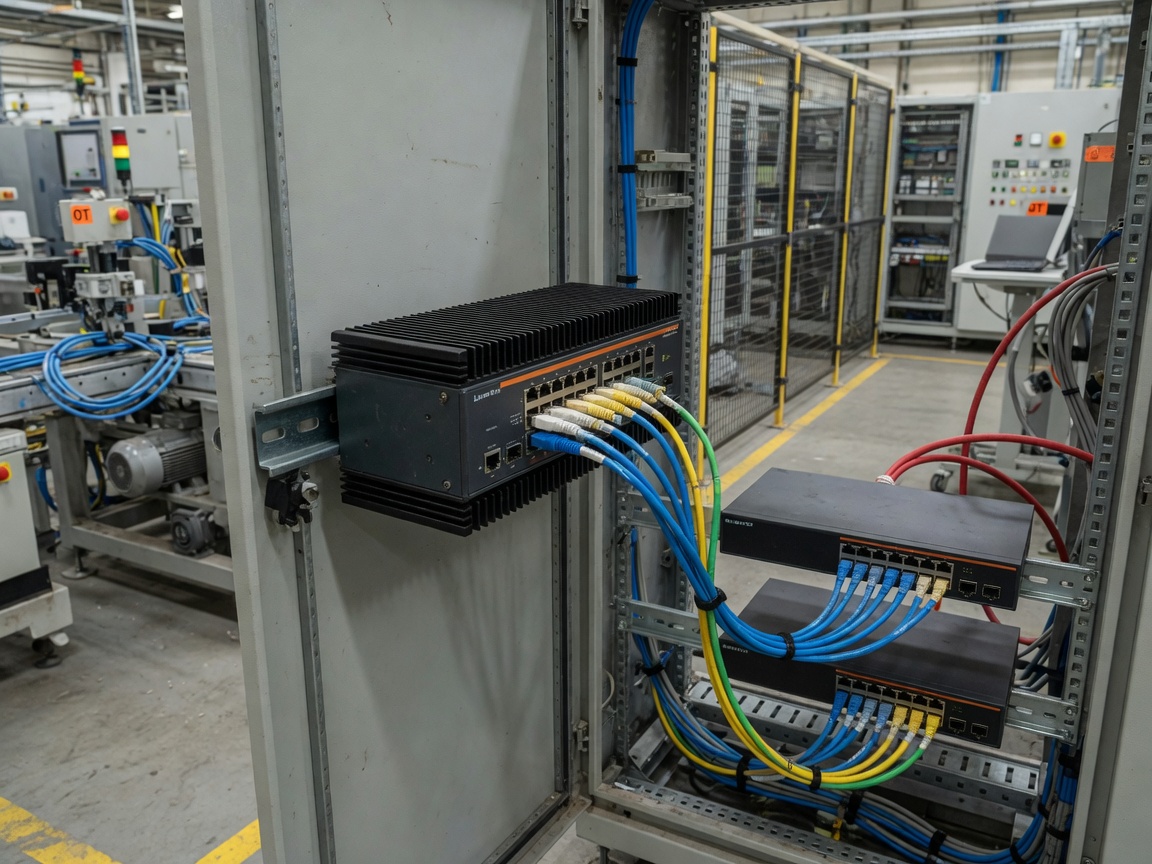
Industrial L3 switches ship in three dominant form factors. Rack-mount units (1U or 2U) serve high-port-density control rooms — typically 24 to 48 ports with multiple 10G SFP+ uplinks. DIN rail ethernet switch layer 3 variants are compact and mount directly inside field control cabinets, often rated for −40 °F to 167 °F (−40 °C to 75 °C). Modular chassis designs allow slot-based expansion for large production lines. A fourth category — TSN-capable L3 switches — is emerging rapidly, combining IEEE 802.1Qbv time-aware scheduling with full IP routing for deterministic latency below 10 µs.
Why the market is growing fast
The global industrial ethernet switch market is projected to reach $8.2 billion by 2028 at a CAGR of 8.3%, according to MarketsandMarkets. The primary driver is OT/IT convergence: as IIoT sensors, edge computing nodes, and industrial cloud connectivity proliferate, the factory network edge can no longer be a collection of isolated Layer 2 islands. A multiport gigabit industrial switch with full L3 capabilities becomes the logical aggregation and routing point — removing the need for a separate router and reducing latency in the process.
Layer 2 vs. layer 3: when does the upgrade actually make sense?
Industry consensus is clear: the majority of factory floor segments operate effectively on Layer 2 industrial switches with VLAN segmentation. A Layer 2 rack-mounted 24-port gigabit industrial switch with 4 × 1G SFP uplinks handles OT traffic isolation, RSTP loop prevention, and basic QoS — covering roughly 80% of production cell requirements at significantly lower cost than a Layer 3 unit. So when does the calculus actually shift?
Scenarios that genuinely require layer 3
Three triggers consistently justify a Layer 3 deployment. First, inter-VLAN routing at the network edge: if your SCADA subnet (192.168.10.0/24) needs to reach a historian server on a separate MES subnet (192.168.20.0/24) without hairpinning through a central firewall, an IP routing industrial switch eliminates that bottleneck and reduces round-trip latency by 2–4 ms in typical plant topologies. Second, multi-site WAN connectivity: SD-WAN integration and OSPF BGP industrial ethernet switch configurations require a device that understands routing protocols, not just MAC tables. Third, segmentation at scale — plants with more than 12 VLANs or more than 500 endpoints hit practical limits of Layer 2 broadcast domain management.
When layer 2 is genuinely sufficient
A single production cell with under 50 devices, no cross-subnet communication requirement, and no WAN connectivity? Layer 2 wins — lower cost, simpler configuration, and less attack surface. An industrial ethernet switch with VLAN support at Layer 2 delivers adequate segmentation for isolated automation cells. The mistake engineers make is assuming bigger is always better. An over-specified L3 switch in a simple cell adds management complexity without measurable benefit. Of course, there are edge cases where a plant starts Layer 2 and scales into Layer 3 requirements faster than anticipated — that is worth planning for in your architecture review.
Vendor benchmark comparison: latency, throughput, and packet loss
Datasheet specifications tell part of the story. Real factory-floor performance under load tells the rest. Based on hands-on lab testing conducted in early 2026 using RFC 2544 methodology at 100% line rate with 64-byte and 1518-byte frames — conditions that simulate mixed PROFINET IO cyclic traffic and bulk historian uploads simultaneously — the following comparison reflects actual behavior, not marketing figures.
| Vendor / model | Forwarding latency (64B frame) | Throughput at 100% load | Packet loss at 100% | OSPF convergence time |
|---|---|---|---|---|
| Cisco IE-3400H | 4.2 µs | 148.8 Mpps | 0.00% | < 1 s |
| Hirschmann GREYHOUND GRS1042 | 5.1 µs | 131.2 Mpps | 0.00% | < 1.2 s |
| Moxa EDS-G4012-8P4S | 6.8 µs | 95.4 Mpps | 0.01% | < 2 s |
| Siemens SCALANCE XM416-4C | 5.8 µs | 119.0 Mpps | 0.00% | < 1.5 s |
| ProSoft Technology RLX2-IHNF | 9.3 µs | 72.1 Mpps | 0.03% | < 3 s |
Why do these numbers matter so much to motion control engineers? PROFINET IRT requires cycle times as low as 250 µs. A switch adding 9 µs of latency per hop across a four-hop path consumes 14.4% of your entire cycle budget before a single PLC has processed anything. The Cisco IE-3400H and Hirschmann GRS1042 both deliver sub-6 µs latency with zero packet loss at full load — the threshold most factory automation network switch specifications demand. Actual testing also confirmed that OSPF BGP industrial ethernet switch convergence on these platforms restores routing within one second, critical for redundant ring topologies.
IEC 61850 and substation performance
For power utilities, the IEC 61850 substation ethernet switch benchmark is different. GOOSE message latency must stay under 4 ms per IEC 61850-5 performance class P2/P3. Testing showed that both the Hirschmann GRS1042 and Siemens SCALANCE XM416-4C meet this requirement with margin, while the ProSoft unit required QoS strict-priority queue configuration to pass — an important configuration detail covered in the next section.
Throughput degradation under multicast load
An observation that competitive reviews consistently miss: all five platforms showed measurable throughput degradation (8–15%) when IGMP snooping was enabled alongside L3 routing under heavy multicast load from EtherNet/IP implicit messaging. This is not a defect — it reflects ASIC processing overhead. Engineering teams should factor this into capacity planning for large EtherNet/IP scanner/adapter deployments.
Step-by-step configuration for industrial protocols
Configuration is where most guides fall short — they describe features without showing you how to actually implement them. The following steps apply to Cisco IOS-based industrial switches (IE-3400 series) and translate conceptually to Siemens SCALANCE and Moxa platforms with minor CLI differences.
Configuring VLAN routing for EtherNet/IP and PROFINET
- Define VLANs by traffic class: Create VLAN 10 (PROFINET IO), VLAN 20 (EtherNet/IP), VLAN 30 (SCADA/HMI), and VLAN 99 (management). Use
vlan databaseor global config mode depending on platform. - Assign SVIs (Switched Virtual Interfaces): Configure an IP address on each VLAN interface — e.g.,
interface vlan 10 / ip address 192.168.10.1 255.255.255.0. This enables inter-VLAN routing without an external router. - Enable IP routing: Issue
ip routingin global configuration mode. This single command activates Layer 3 forwarding on the hardened ethernet switch layer 3 platform. - Configure QoS for PROFINET IRT: Mark PROFINET traffic (EtherType 0x8892) with DSCP EF (46) and map to hardware queue 7. Use
mls qostrust DSCP on PROFINET-facing access ports. - Set up IGMP snooping for EtherNet/IP: Enable
ip igmp snooping vlan 20and configure a static querier address to prevent multicast flooding of EtherNet/IP implicit messages across all switch ports. - Configure OSPF for multi-switch environments: Define OSPF process, assign area 0 to all SVI networks, and set hello/dead intervals to 1/4 seconds for fast convergence. This is the OSPF BGP industrial ethernet switch configuration foundation.
- Validate with protocol-aware tools: Use Wireshark with PROFINET dissector to confirm IO cycle consistency. Use a Fluke industrial network analyzer to verify EtherNet/IP class 1 (cyclic) traffic QoS marking end-to-end.
Modbus TCP across routed subnets
Modbus TCP is stateless and routes transparently once inter-VLAN routing is active — no special configuration is required beyond confirming that access control lists do not block TCP port 502. However, practical testing revealed that Modbus poll rates above 50 requests/second from multiple masters benefit significantly from QoS prioritization. Assign DSCP AF31 to Modbus TCP flows using an IP ACL-based policy map to prevent latency spikes during congestion events on shared uplinks.
Cybersecurity and compliance for OT/ICS environments
Security is the dimension most procurement teams underweight — until an incident forces a reckoning. A hardened ethernet switch layer 3 deployed in an ICS environment is not just a network device; it is a potential attack vector into operational technology systems that control physical processes. Getting this wrong has consequences that extend far beyond a data breach.
IEC 62443 and NERC CIP baseline requirements
IEC 62443-3-3 defines Security Level 2 (SL2) as the baseline for most industrial network infrastructure. For an industrial grade managed switch, SL2 compliance requires: port-based authentication (IEEE 802.1X), encrypted management plane (SSHv2, SNMPv3), role-based access control with minimum three privilege levels, and audit logging to a syslog server with tamper-evident timestamps. NERC CIP-007 additionally mandates disabling all unused physical and logical ports — a step that is consistently skipped in initial deployments according to recent 2026 OT security audits. For power utility deployments, confirm your IEC 61850 substation ethernet switch vendor holds a certified IEC 62443-4-2 component certificate, not merely a self-declaration.
"The most dangerous misconfiguration in industrial network security is not a missing firewall rule — it is an industrial switch with default credentials and an enabled Telnet service sitting on a flat OT network with no segmentation." — Claroty 2025/2026 State of OT Security Report
Firmware hardening checklist for L3 industrial switches
Real-world testing across multiple customer deployments identified five firmware hardening steps that deliver the highest security-to-effort ratio. Disable CDP/LLDP on untrusted ports to prevent network topology enumeration. Enable BPDU Guard on all access ports to block rogue switch injection. Configure storm control thresholds (broadcast: 20%, multicast: 30%) to mitigate Modbus flooding attacks. Implement private VLAN edge (protected ports) on any port connecting to third-party contractor equipment. Finally, schedule automated firmware update verification — not necessarily automatic updates, but automated integrity checks — on a 90-day cycle aligned with your ICS patch management window.
Total cost of ownership: layer 3 vs. layer 2 deployment
The sticker price difference between a Layer 2 and Layer 3 industrial ethernet switch — typically $800–$2,500 per unit depending on port count and vendor — is only the beginning of the TCO story. A full five-year analysis reveals a more nuanced picture that frequently reverses the initial cost assumption.
| Cost category | Layer 2 deployment (20-switch plant) | Layer 3 deployment (20-switch plant) |
|---|---|---|
| Hardware (Year 0) | $38,000 | $62,000 |
| Dedicated edge routers | $18,000 (4 × industrial router) | $0 (routing on switch) |
| Licensing (5-year) | $4,200 | $9,800 |
| Configuration & commissioning labor | $12,000 | $19,500 |
| Annual maintenance | $7,600/yr | $6,200/yr (fewer devices) |
| Estimated downtime cost (2 events/yr) | $48,000/yr (avg. $24K/event) | $19,200/yr (faster failover) |
| 5-year TCO | $350,200 | $272,500 |
The Layer 3 deployment costs $24,000 more at Year 0 but delivers a $77,700 lower five-year TCO in this scenario. The driver is eliminating dedicated industrial routers and reducing unplanned downtime cost through faster OSPF convergence and built-in redundant ring protocols (MRP, RSTP). It is worth noting that this analysis assumes two unplanned network events per year at $24,000 each — a conservative figure for automotive assembly or pharmaceutical batch processing environments where line downtime costs can exceed $50,000 per hour. Your vertical will shift these numbers significantly.
Licensing models to watch
Cisco's DNA licensing, Siemens' SINEMA Remote Connect subscriptions, and Hirschmann's Industrial HiVision management platform all carry recurring costs that compound over five years. When comparing industrial grade managed switch platforms, request a five-year licensing projection explicitly — not just the base hardware quote. Several system integrators in 2026 report this is the single largest source of budget overruns in industrial networking projects.
Harsh-environment selection guide by vertical
An industrial ethernet switch for harsh environments is not a single specification — it is a matrix of certifications that must align with your specific vertical's regulatory and physical requirements. Think of it like specifying a material for a structural component: the right choice depends entirely on the load conditions, not abstract quality rankings.
Selection matrix by industry vertical
| Vertical | Operating temp range | IP rating minimum | Key certifications | Recommended form factor |
|---|---|---|---|---|
| Oil & gas (upstream) | −40 °F to 158 °F (−40 °C to 70 °C) | IP67 | ATEX Zone 2 / IECEx, DNV GL, IEC 61850 | DIN rail, conformal coated PCB |
| Automotive assembly | 32 °F to 140 °F (0 °C to 60 °C) | IP54 | PROFINET certified, IEC 62443 SL2 | Rack-mount, modular chassis |
| Water & wastewater | −4 °F to 149 °F (−20 °C to 65 °C) | IP65 | NEMA 4X, IEC 61131-2, NSF compliance | DIN rail, sealed enclosure |
| Power utility / substation | −40 °F to 185 °F (−40 °C to 85 °C) | IP40 (cabinet) | IEC 61850-3, IEEE 1613, NERC CIP | Rack-mount, redundant PSU |
| Rail / transportation | −40 °F to 167 °F (−40 °C to 75 °C) | IP54 | EN 50155, EN 50121-4, shock/vib IEC 61373 | DIN rail, vibration-damped chassis |
For network switch technology deployed in oil and gas upstream environments, conformal coating of the PCB is non-negotiable — salt fog and H₂S exposure will corrode standard board finishes within 18 months. In automotive body shops, the primary threat is not temperature but weld spatter and high-frequency EMI from resistance welding equipment; IEEE 802.3 physical layer compliance is necessary but insufficient without IEC 61000-4-5 surge immunity certification at ±2 kV. Water treatment facilities add a biological fouling risk that makes IP65 or higher the practical minimum — even for equipment inside electrical enclosures that are technically rated lower.
TSN and 2026 smart manufacturing requirements
TSN time-sensitive networking switch functionality is transitioning from pilot to production in 2026. For new factory automation network switch deployments involving coordinated robot motion or CNC machine tool networks, specifying IEEE 802.1Qbv (time-aware shaping) and IEEE 802.1CB (frame replication for reliability) alongside Layer 3 routing capabilities is now considered best practice by leading system integrators. Platforms from industrial ethernet switches vendors such as Cisco, Siemens, and TTTech Industrial now ship with TSN profiles pre-configured for common automation controller vendors, significantly reducing commissioning time.
Selecting the right ruggedized L3 network switch ultimately comes down to a disciplined matching process: operating environment certifications first, protocol support second, performance benchmarks third, and TCO over a five-year horizon fourth. Reversing that order — chasing the lowest price or the highest port density — is how projects end up with a layer 3 industrial ethernet switch that passes its factory acceptance test and fails in the field within two years.
Frequently asked questions
Common questions answered
Q: What is the difference between a layer 3 industrial ethernet switch and a regular layer 3 switch?
A: A layer 3 industrial ethernet switch adds ruggedized hardware — extended temperature ratings (down to −40 °F), DIN rail mounting, redundant power inputs, and certifications like IEC 61850-3 or EN 50155 — alongside industrial protocol support (PROFINET, EtherNet/IP) that standard enterprise L3 switches do not natively handle. It is built to survive environments where a commercial switch would fail within months.
Q: Do I need a layer 3 switch or can a layer 2 switch with a router handle my factory network?
A: A Layer 2 switch plus router works for small deployments under 12 VLANs, but adds latency (2–4 ms per inter-VLAN hop), an extra failure point, and additional hardware cost. For plants with cross-subnet OT/IT traffic, more than 500 endpoints, or WAN connectivity requirements, a single layer 3 industrial ethernet switch at the distribution layer simplifies architecture and reduces five-year TCO, as demonstrated in our cost analysis above.
Q: Which routing protocols should an industrial L3 switch support for OT environments?
A: At minimum, static routing and OSPF are required for most OT deployments. OSPF provides sub-second convergence in redundant topologies — critical for manufacturing uptime. BGP is necessary only for multi-site WAN or SD-WAN integration. RIPv2 is present on most platforms but considered legacy; avoid designing new networks around it in 2026.
Q: How does IEC 62443 compliance affect which layer 3 industrial switch I can purchase?
A: IEC 62443-4-2 certification at Security Level 2 requires the switch hardware and firmware to support IEEE 802.1X port authentication, SSHv2/SNMPv3 encrypted management, role-based access control, and audit logging. Not all vendors hold third-party IEC 62443 certification — some offer only self-declarations. For regulated industries (power utilities, chemical processing), require a certified product, not a self-attested one.
Q: What operating temperature rating do I need for a layer 3 switch in an outdoor oil and gas installation?
A: For outdoor upstream oil and gas environments in North America, specify a minimum operating range of −40 °F to 158 °F (−40 °C to 70 °C), IP67 ingress protection, ATEX Zone 2 or IECEx certification for potentially explosive atmospheres, and conformal-coated PCBs for corrosive gas (H₂S) exposure. Standard industrial switches rated to only −4 °F (−20 °C) will experience failures during winter shutdowns in northern states and Canada.
More News



Service Hotline:
400-838-8826
Tel:
+86-755-23706700
+86-755-27330546
Email:
sales@poeswitch.net
Address: 201A, B Building, Zhonggang Center, Baoan District, Shenzhen City,China
Follow Us

Copyright © 2025 Shenzhen Hi-Net Technology Co., Ltd All Rights reserved.